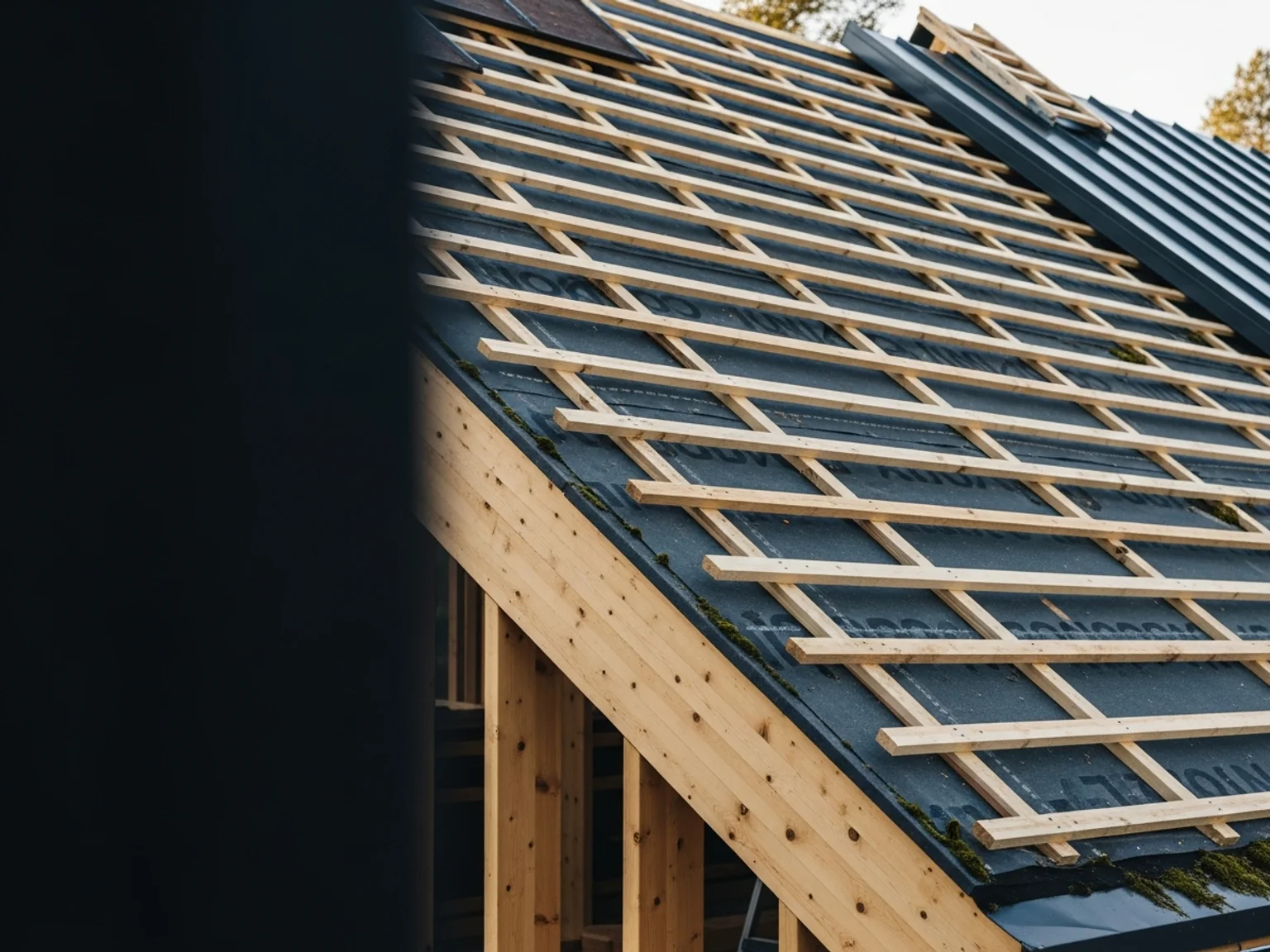
Batten lathing is a critical component of the roof structure that forms the fixing substrate for the roofing material. Battens are installed horizontally on top of the underlayment, and their function is to transfer roof loads — the weight of the roofing material, snow loads, and wind loads — evenly to the roof trusses or rafters. Without correctly dimensioned and installed batten lathing, the roofing material will not stay in place and the roof will not perform as designed. The type and spacing of the batten lathing varies according to the roofing material. Metal roofing, tile roofing, and felt roofing each require different batten spacings and dimensions. Finnish building regulations and the roofing material manufacturers' installation instructions specify the exact requirements that must be followed to ensure roof performance and warranty compliance. The quality of the batten lathing directly affects the service life of the roof. Warped, cracked, or undersized battens cause distortion of roof profiles, loosening of fixings, and ultimately roof leaks. Battens must be straight, dry, and made from pressure-treated or spruce tongue-and-groove timber.
Batten Dimensions and Spacing
The most common batten sizes are 22×100 mm and 32×100 mm. The thinner 22 mm batten is sufficient for most metal roofing applications where the batten spacing is 350–400 mm and loading is moderate. The heavier 32 mm batten is needed for tile roofing, where an individual tile can weigh over 4 kg and the total weight of the covering exceeds 50 kg/m².
The batten spacing (centre-to-centre measurement) is determined by the profile of the roofing material. On a metal roof, the profile requires support points at specific intervals, typically 300–400 mm. On a tile roof, the batten spacing corresponds to the exposed part of the tile — generally around 320–370 mm depending on the tile type. At the eaves and ridge, the batten spacing differs from the standard, and the first batten is always closer to the edge of the eaves.
In addition to spaced battening, close boarding is also used, where the boards are installed tight against each other. Close boarding is required on low-pitch roofs (below 1:5), at valley gutters, and in the eaves area. Close boarding can be replaced with plywood or OSB board, in which case it is referred to as sheet sarking.
Installation and Materials
Battens are fixed onto counter battens (also known as racking battens) installed on top of the underlayment, which raise the battens away from the underlayment and create a ventilation gap. The counter batten dimension is typically 22×50 mm or 32×50 mm. The ventilation gap ensures air circulation above the underlayment, which dries out condensation.
Battens are nailed to the counter battens with hot-dip galvanised nails. The nail size is 75 mm or 100 mm depending on the thickness of the batten. Each batten is nailed to every counter batten with two nails. The nails must pass through the batten and counter batten and penetrate at least 30 mm into the upper chord of the roof truss.
Spruce is the preferred timber, being straight-grained and having few knots. Pressure-treated timber is used particularly for eaves-area battens, where moisture conditions are more demanding. The moisture content of the battens must be below 20% at the time of installation, as wet timber shrinks and warps as it dries, loosening fixings.
Common Mistakes and Quality Assurance
The most common batten lathing mistake is incorrect batten spacing. If the spacing deviates from the roof covering manufacturer's instructions, the fixing points of the roofing material do not line up with the battens, which weakens the roof's wind resistance and can damage the covering. Especially with tile roofing, a deviation of just a few millimetres in the batten spacing compounds over the length of the roof and causes problems at the ridge.
Another common mistake is using warped boards. A twisted batten lifts the roof covering away from the fixing substrate, allowing wind to get underneath the roof profiles and, in the worst case, tearing off the covering. Every batten must be visually inspected before installation and defective boards rejected.
Quality assurance involves checking the consistency of batten spacings with a tape measure at multiple points along the roof slope. Particular attention is paid to the first batten spacing at the eaves and the last at the ridge, as these always differ from the standard spacing. Batten straightness is checked with a string line, and individual dips or bumps are levelled by shimming before the roof covering is installed.
Related terms
Request a roofing quote and enter a draw for a €1,000 gift card!
Submit a quote request — you're automatically entered. Winner drawn on 30 June 2026.
€1,000 gift card
Valid for all our roofing services
All quote requests are automatically entered. Rules: kotikatto.fi/arvonta
Content reviewed and verified
Updated: April 2026