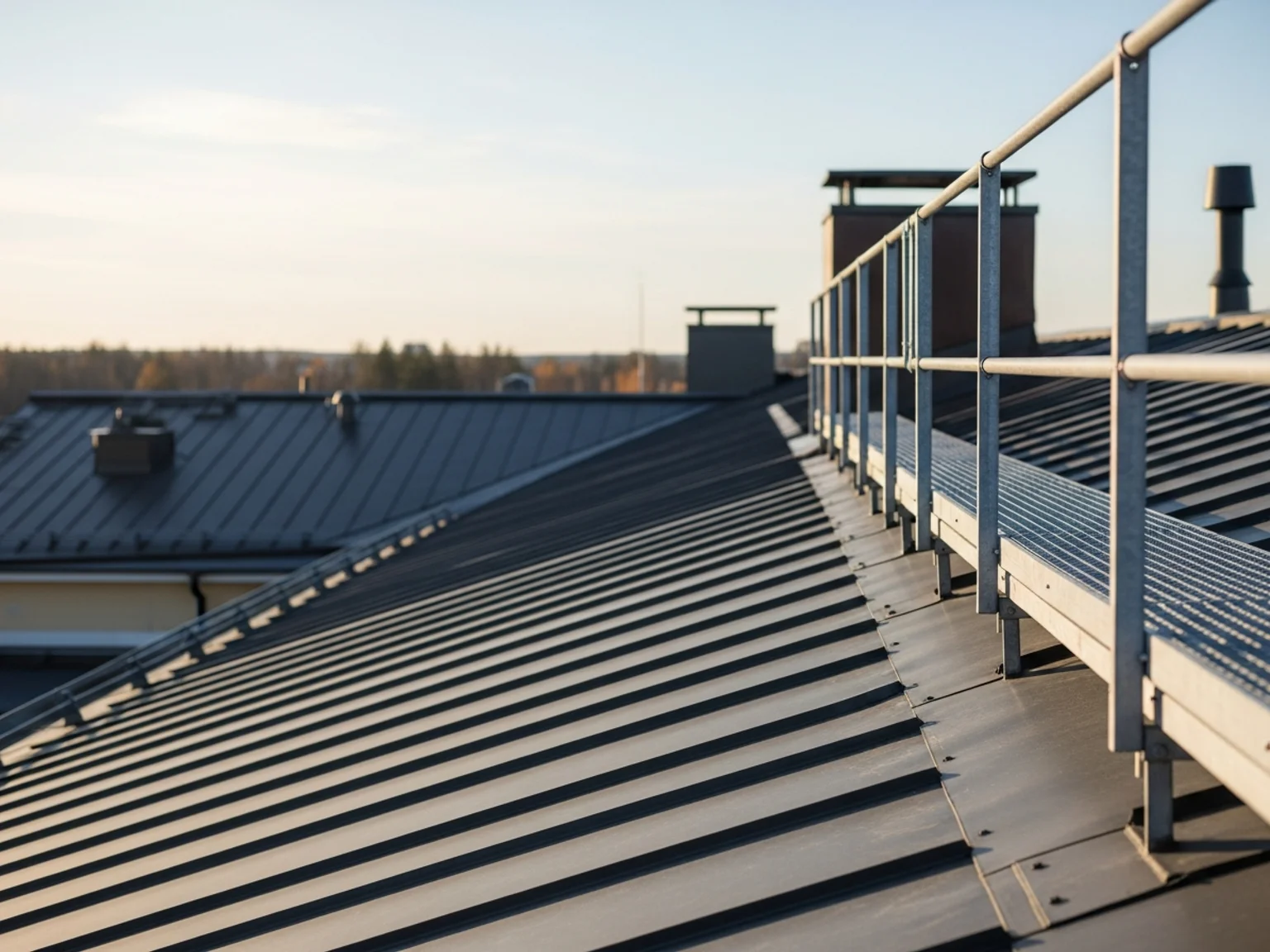
A roof walkway is a horizontal platform installed on the roof slope that enables safe lateral movement across the roof surface. Unlike roof ladders, which are climbed vertically, a roof walkway provides a stable passage along the ridge direction. It is an essential component when a maintenance point — such as a chimney or ventilation pipe — is not located directly above the access ladders. Roof walkways are governed by the same legislation as other roof safety products: the Land Use and Building Act, the Ministry of the Environment decree on safety of use and the Rescue Act. The RT 85-11132 guideline card defines the installation details. A roof walkway is part of the roof safety plan prepared at the building permit stage. A roof walkway is especially important on steep roofs where movement without a fixed platform is dangerous and impossible without safety harnesses. Even on gentler slopes, a walkway significantly improves workplace safety and speeds up maintenance work, as there is no need to balance on the roofing material alone.
Structure and dimensions of roof walkways
A roof walkway consists of a walking platform and mounting brackets. The platform is typically a 300–350 mm wide grating or perforated sheet that provides a sturdy, non-slip foothold. The material is hot-dip galvanised steel or aluminium, and the surface is often anti-slip treated for enhanced safety.
Roof walkways are available in various lengths, typically in 1.0–3.0 metre sections. Sections can be joined with connectors, so the overall length is not limited by the size of a single unit. The walkway platform must be at least 250 mm wide in accordance with standard SFS-EN 516.
The mounting brackets raise the walkway approximately 50–100 mm above the roofing material. Brackets are fixed to the battens or load-bearing structure through the roofing material. The brackets must withstand a minimum point load of 1.5 kN and must be adjustable for roof pitch. The adjustability ensures the platform remains horizontal at all roof pitches.
Positioning and planning
Roof walkway positioning is based on the roof safety plan, which defines a safe route to every maintenance point. A typical route runs from the access ladders up via roof ladders and along the walkway laterally to the maintenance point. The walkway is usually installed near the ridge so it serves as many points as possible.
For chimney maintenance, the walkway is placed near the chimney so the sweep can stand stably on the walkway while working. Antenna and ventilation pipe maintenance similarly requires a walkway to each device. Where maintenance points are on several roof slopes, a ridge walkway that crosses the ridge and connects the routes on different slopes is needed.
The roof safety plan is normally prepared by the roofing contractor or designer as part of the roof renovation or new construction design. The plan takes into account the roof shape, pitch, locations of maintenance points and rescue authority requirements. A well-designed route network minimises the number of products needed and costs.
Installation and fixing
Roof walkway installation follows the same principle as other roof safety products: fixing is made through the roofing material into the load-bearing structure with proper seals. Sealing the fixing points is critical, as every penetration is a potential leak point.
On profiled metal roofs, the mounting bracket is shaped to match the roof profile and the seal is compressed against the profile ridge. On standing-seam roofs, special crimp clips are used that attach to the seam without screws — this preserves the watertightness of the covering. For tile roofs, installation uses a bracket that slides under the tiles.
The installation sequence is usually: first access ladders, then roof ladders, then the roof walkway and finally snow guards. This order ensures the installer has a safe route available during the installation work itself. It is advisable to have the installation carried out by the same contractor who does the roofing, as they know the roof structure and can select the correct fixings.
Costs and maintenance
The price of a roof walkway is typically 50–100 euros per metre for materials. Installation cost is approximately 40–60 euros per metre. The typical roof walkway cost for a detached house is 300–800 euros installed, depending on the total length required.
A roof walkway is a virtually maintenance-free product. In the annual inspection, it is verified that the mounting brackets have a firm grip, the platform is intact and the joints are in good condition. In winter, snow and ice can accumulate on the walkway, so it must be cleared before use. The anti-slip surface wears over time but is rarely a barrier to use.
The service life of a roof walkway matches that of other roof safety products — hot-dip galvanised steel lasts 30–50 years. During a roof renovation it is advisable to renew the walkway, as removing and reinstalling the old one is more laborious than installing a new walkway. Overall, a roof walkway is an affordable investment that pays for itself through safer and easier roof maintenance.
Related terms
Want to learn more?
Read the full guide on this topic→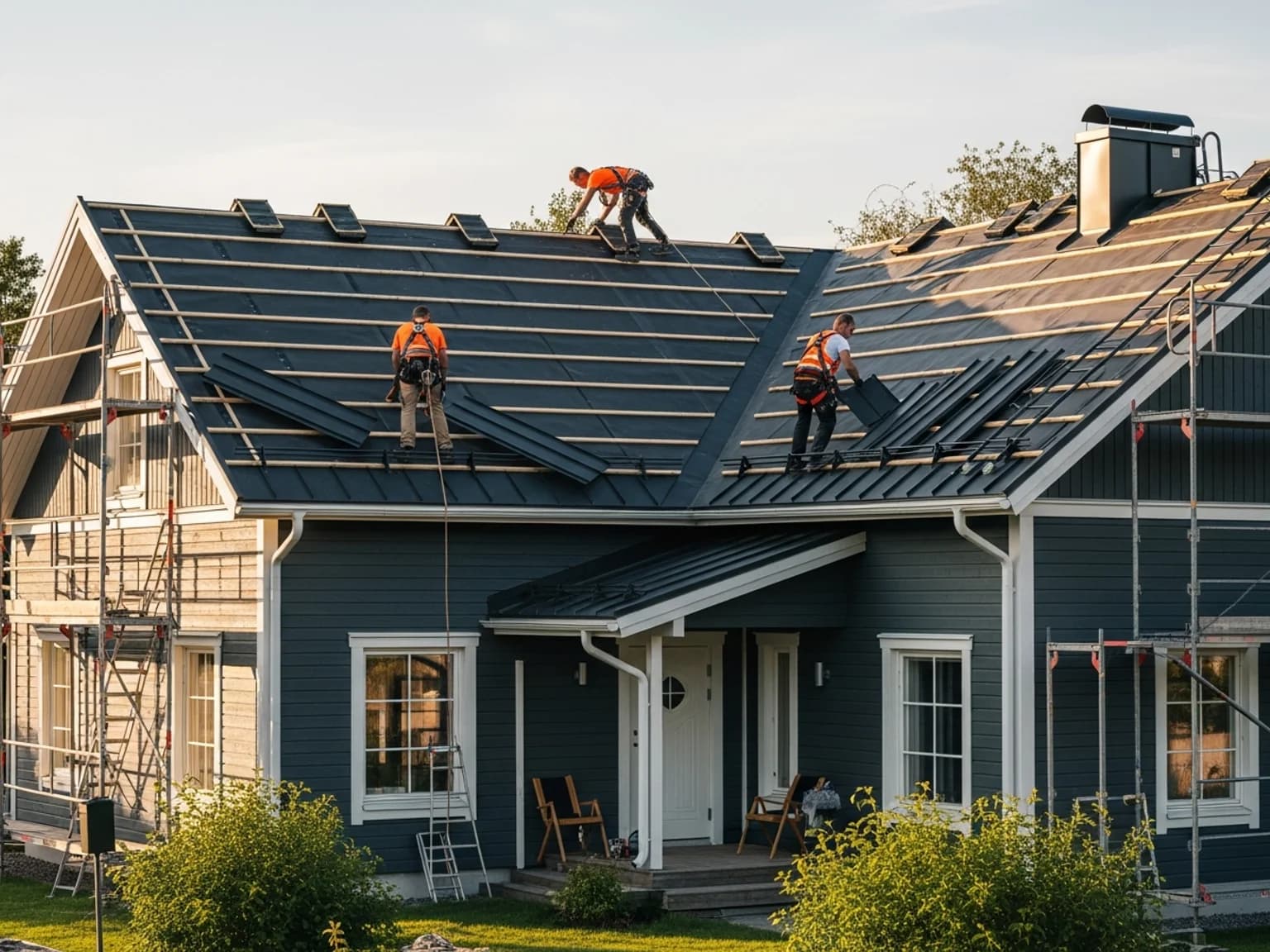
Request a roofing quote and enter a draw for a €1,000 gift card!
Submit a quote request — you're automatically entered. Winner drawn on 30 June 2026.
€1,000 gift card
Valid for all our roofing services
All quote requests are automatically entered. Rules: kotikatto.fi/arvonta
Content reviewed and verified
Updated: April 2026