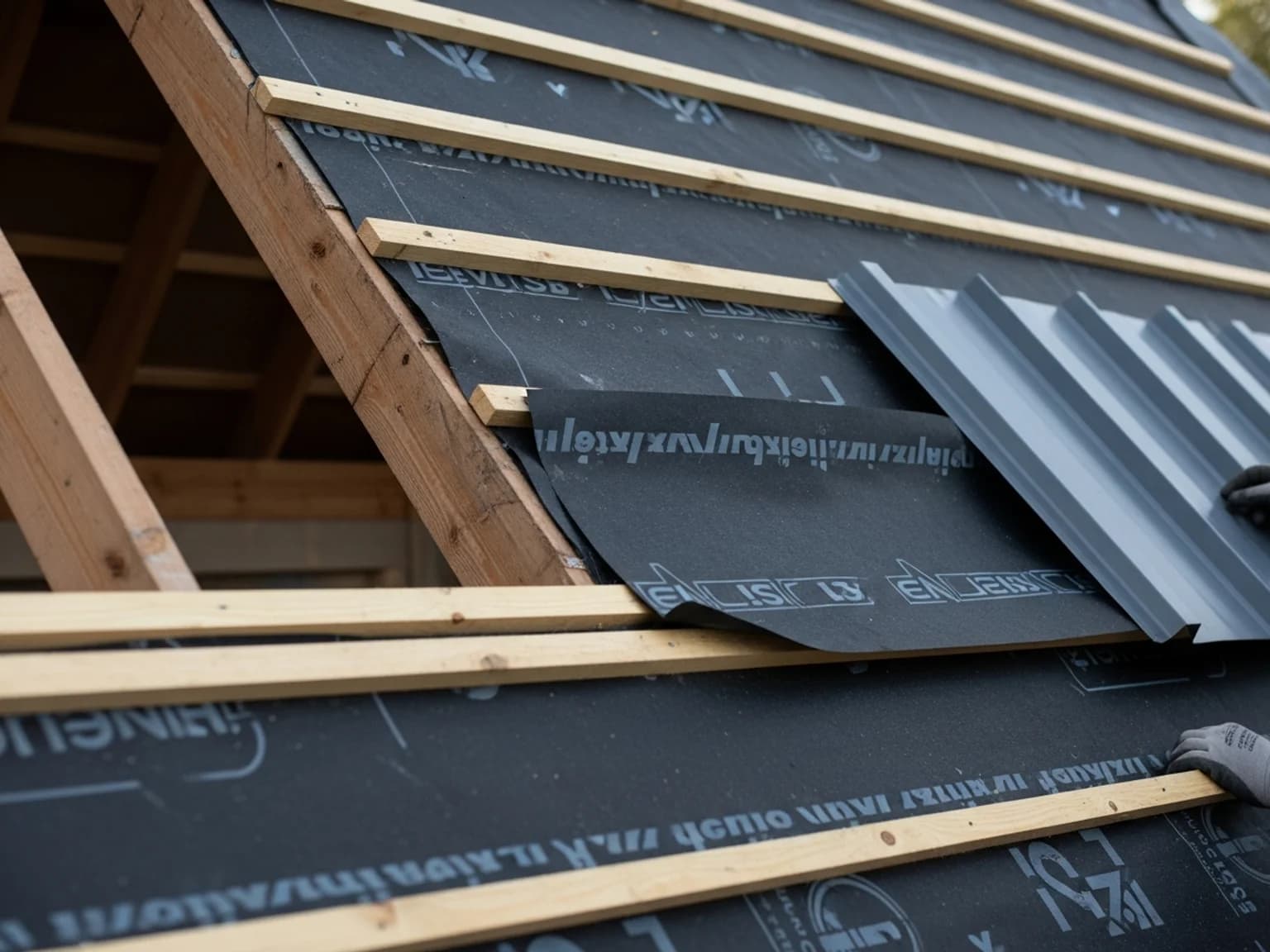
Roofing underlayment is a waterproof layer installed between the roof covering and the batten lathing, serving as the roof's secondary water barrier. Its primary function is to channel condensation forming on the underside of the roofing material and any leaks safely to the eaves before moisture can reach the roof structure. Without underlayment, even a single cracked roof tile or a loosened metal roofing screw can cause extensive moisture damage. Finnish building regulations require underlayment to be installed in all new-build roof structures. During a roof renovation, the underlayment must also be replaced if the existing membrane is damaged or missing entirely. When selecting an underlayment, the roof pitch, ventilation design, and roofing material must all be considered — the wrong type of underlayment can cause moisture problems just as readily as a missing one. The importance of roofing underlayment cannot be overstated: it is the second most critical waterproofing layer in the roof system, right after the primary roofing material. Especially on metal roofs, where screw penetration points and condensation are unavoidable, the underlayment is the only protection preventing moisture from reaching the substructure.
Types of Underlayment and Their Properties
Roofing underlayments are divided into two main types: vapour-permeable (breathable) and vapour-barrier underlayments. A vapour-permeable underlayment allows water vapour to pass through while stopping liquid water. This is the most common type in Finland because it enables the roof structure to dry upward. A breathable underlayment typically has an sd value below 0.3 m.
A vapour-barrier underlayment, on the other hand, blocks both liquid water and water vapour. It is used in special situations such as cold roof structures or very low-pitch roofs where moisture management requires a complete vapour barrier. Choosing the wrong type can lead to moisture accumulation within the structure.
In terms of material, underlayments are generally made from polyethylene or polypropylene fibre fabrics. The highest-quality products withstand UV radiation for several months, allowing time for roof installation. The mechanical strength of the underlayment is an important property — during installation the membrane is exposed to wind and mechanical stress, so a weak material tears easily.
Installation and Critical Details
The underlayment is installed horizontally from the lower eaves toward the ridge, with the upper layer overlapping the lower one by at least 150 mm. This overlap ensures that water always flows downward and cannot penetrate through the seams into the structure. On low-pitch roofs (below 1:5), the overlap is increased to 200 mm.
The underlayment is secured by the batten lathing to the roof trusses or rafters. The membrane should sag slightly between the battens — approximately 20–30 mm — so that condensation flows over the raised point at each batten rather than pooling. An underlayment stretched too tightly directs water straight to the batten and nail location, increasing the risk of leaks.
At the ridge, the underlayment is left open by approximately 50–100 mm to ensure a ventilation gap, unless a separate ridge ventilation strip is used. At the eaves, the lower edge of the underlayment is directed over the gutter so that condensation ends up in the rainwater system rather than running onto the wooden components of the roof structure. At penetration points, the underlayment is overlapped tightly around the penetration fitting and sealed with specialist tape.
Underlayment Damage and How to Identify It
Underlayment damage is a common cause of roof leaks, particularly in roof structures that are 15–25 years old. Early underlayment materials were weaker than current products and become brittle under the effects of UV radiation and temperature fluctuations. Damaged underlayment typically leaks at isolated points, making the leak location difficult to pinpoint.
Typical signs of damage include moisture marks on the wooden components of the roof space, a musty smell in the attic, and moisture accumulation in the insulation. If damage is suspected, a roof-space inspection must be carried out without delay. Even a small moisture problem can progress quickly into a larger one as wooden components begin to rot and insulation loses its thermal performance.
Replacing the underlayment requires the complete removal of the roofing material, making it a significant cost item. For this reason, the underlayment should always be replaced during a roof renovation, even if it still appears intact. The cost of new underlayment is only a fraction of the total roof renovation price, but its absence can ruin the entire renovation.
Related terms
Request a roofing quote and enter a draw for a €1,000 gift card!
Submit a quote request — you're automatically entered. Winner drawn on 30 June 2026.
€1,000 gift card
Valid for all our roofing services
All quote requests are automatically entered. Rules: kotikatto.fi/arvonta
Content reviewed and verified
Updated: April 2026