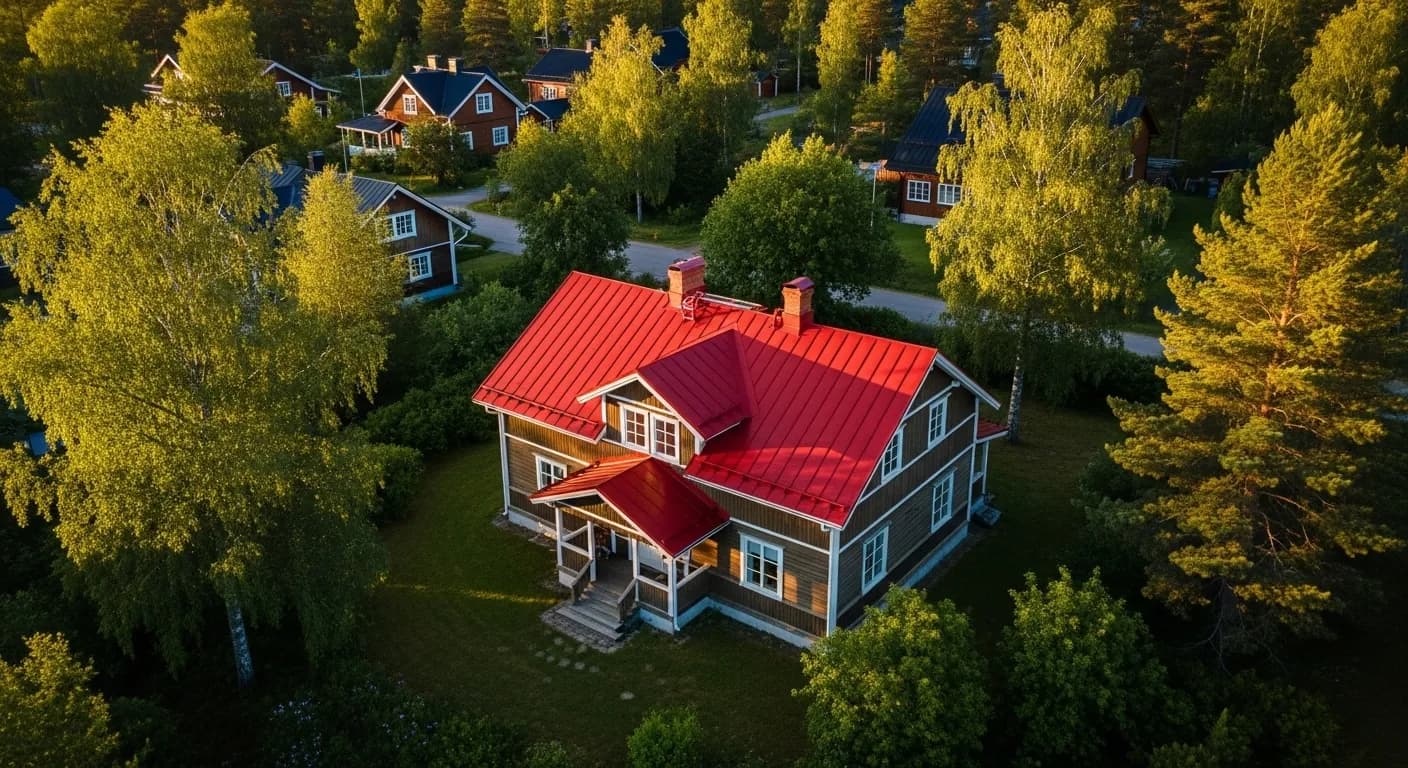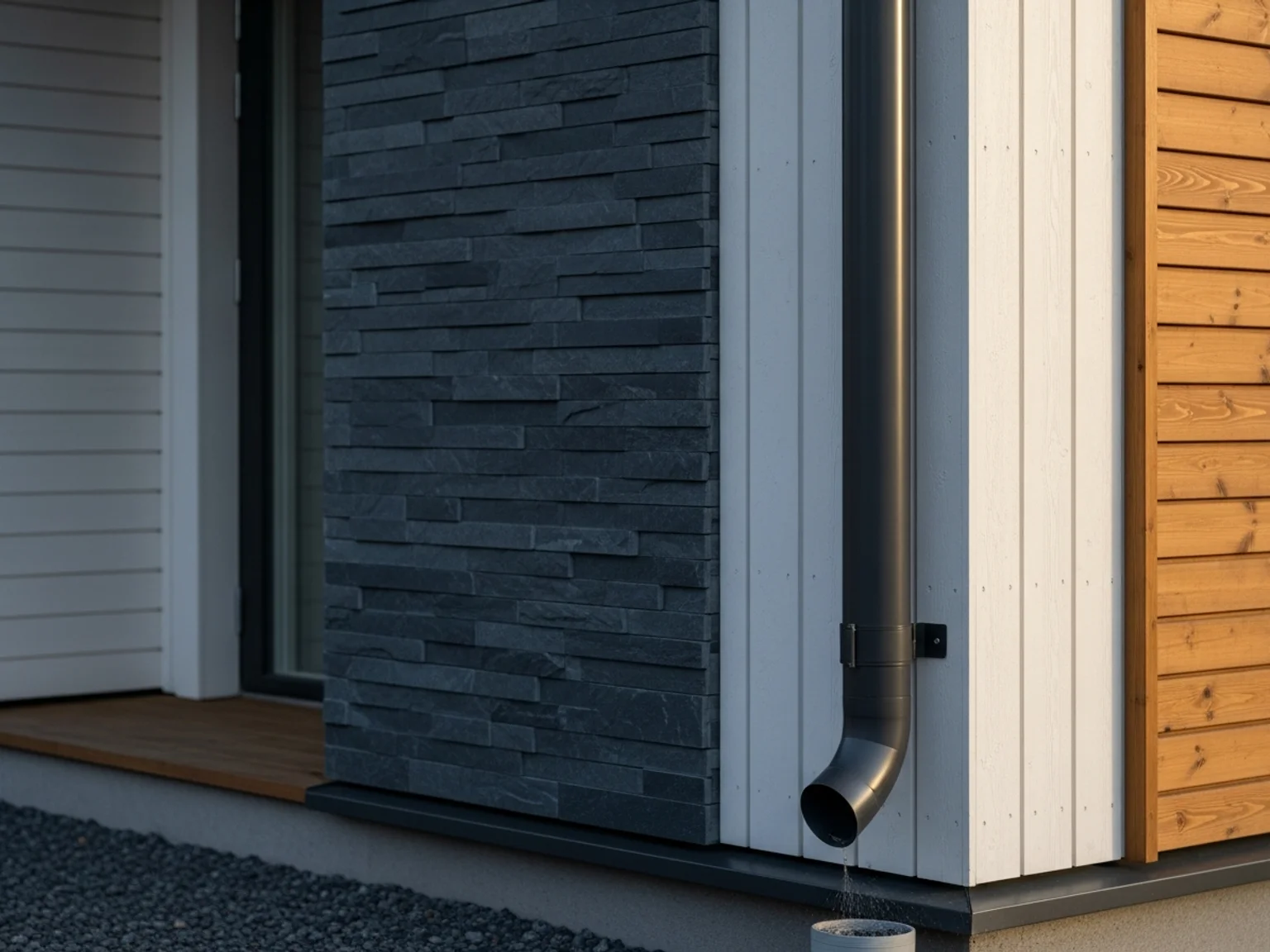
Downspouts are the vertical components of a stormwater system that transport water collected by the eaves gutters from the roof down to ground level. There, the water is directed to either a stormwater drain, a municipal surface water sewer or a splash block. Without downspouts, water would fall freely from the eaves to the ground, causing erosion, plinth moisture damage and foundation deterioration. The functionality of a downspout affects the efficiency of the entire stormwater system. A blocked or undersized downspout causes water to back up in the gutter, where it overflows or, when freezing, breaks the gutter system. In Finnish conditions, where annual rainfall is 500–750 mm and winter meltwater can be abundant, correct dimensioning and maintenance of downspouts is particularly important. Downspout installation and dimensioning are carried out in tandem with the gutter system. In Finland, the guidance of the RT building information cards is followed, and the design takes into account the roof area, roof pitch and local design rainfall. Building regulations require that rainwater must not flow uncontrolled onto the building's foundations.
Downspout dimensions and materials
Standard downspout diameters in Finland are 75 mm, 87 mm and 100 mm. In single-family houses, the most common size is 87 mm (round) or the equivalent square pipe. The larger 100 mm pipe is needed when a single downspout serves a roof area of more than 50 m². The materials correspond to the gutter system: galvanised steel, painted steel, copper or plastic.
Painted steel is by far the most popular material for downspouts because it is durable, affordable and available in a wide colour palette. The colour is typically chosen to match the facade or the eaves gutter. Copper is an architecturally prized solution that develops a beautiful green patina over the years.
The wall thickness of steel downspouts is typically 0.5–0.6 mm. Thinner materials are more susceptible to mechanical damage — for example from the weight of snow masses, dents from ladders and expansion caused by freezing. Fixing clamps (bracket sets) are installed at approximately 1.5–2 metre intervals on the wall.
Placement and dimensioning
The basic principle for downspout placement is that there should be no more than 10–15 metres of gutter line per downspout. In practice, for a single-family house this typically means 2–4 downspouts per eaves line — corners are the most natural locations. If the gutter line is over 15 metres, an additional downspout is installed in the middle.
Dimensioning takes into account the catchment area of the roof and the local design rainfall intensity. In Finland, the design rainfall varies from 0.010–0.020 l/(s·m²) depending on the region. For example, for a 100 m² roof area with a design rainfall of 0.015 l/(s·m²), the required flow rate is 1.5 l/s, which requires at least one 87 mm downspout.
The connection of the downspout base to the ground is a critical point. The best solution is a fixed connection to a stormwater drain or surface water sewer. If a municipal system is not available, a splash block is used that directs water at least 3 metres away from the building. However, a splash block is only a secondary solution.
Installation and connections
The top of the downspout connects to the gutter through a funnel (outlet cone). The funnel is a conical piece attached to the bottom of the gutter that directs water to the narrower downspout. The connection between the funnel and gutter must be watertight but not completely airtight — a small air hole at the top of the funnel prevents vacuum formation and improves flow.
The downspout is installed next to the wall with fixing clamps that are screwed into the wall structure. The clamp spacing is typically 1.5–2 metres, and they allow vertical thermal movement of the pipe. This is important because a 6-metre-long steel pipe moves approximately 4 mm with a temperature difference of -30°C to +30°C.
Changes in wall line (for example from the eaves to the wall line) are made with 15° or 30° elbow fittings. Sharp 90° bends should be avoided because they slow flow and are more prone to blockage. It is particularly important in Finland that there are no horizontal sections in the downspout — standing water freezes in winter and breaks the pipe.
Maintenance and problem prevention
The most common problem with downspouts is blockage. Leaves, needles and debris accumulate in the funnel and inside the pipe, especially at bends and narrowing points. A blocked downspout causes the gutter to overflow and in winter an ice dam that can damage the entire eaves structure. Cleaning is done together with the gutters twice a year.
Cleaning is carried out by flushing the pipe from above with a garden hose or pressure washer. If the blockage does not come loose, a drain cable is used. Debris filters (leaf guards) are available for funnels, which prevent most debris from entering the pipe. However, the filter must be cleaned regularly.
Freezing is a serious risk factor for downspouts in Finland. Frozen water can crack the pipe or detach the fixing clamps. A self-regulating heating cable is installed in the downspout in a loop shape — the cable runs down and back up. The power requirement is 40–50 W/m. A heating cable is practically a mandatory investment in northern Finland's conditions, and is highly recommended in southern Finland as well.
Related terms
Want to learn more?
Read the full guide on this topic→
Request a roofing quote and enter a draw for a €1,000 gift card!
Submit a quote request — you're automatically entered. Winner drawn on 30 June 2026.
€1,000 gift card
Valid for all our roofing services
All quote requests are automatically entered. Rules: kotikatto.fi/arvonta
Content reviewed and verified
Updated: April 2026