A drainage system is an underground dewatering system consisting of perforated pipes, drainage gravel and filter fabric. Its purpose is to collect water moving through the soil — seepage water, groundwater and rainwater percolating towards the foundations — and direct it away from the building's foundations in a controlled manner. A functioning drainage system is a prerequisite for dry basement and ground-floor spaces. According to Finnish building regulations (formerly RakMK C2, now the Ministry of the Environment decree), all residential buildings with ground-contact structures must have a functioning drainage system. Missing or malfunctioning drainage is the single most common cause of moisture and mould damage in Finnish single-family houses. In houses built before the 1970s in particular, drainage was not always installed at all. The drainage system is closely linked to the stormwater system, but it is important to understand the difference: the stormwater system (gutters, downspouts, stormwater drains) handles roof surface water, while drainage handles water in the soil. The water from these two systems must generally not be combined in the same pipe network without municipal permission, because during heavy rain, stormwater could back up the drainage pipe.
Drainage system structure
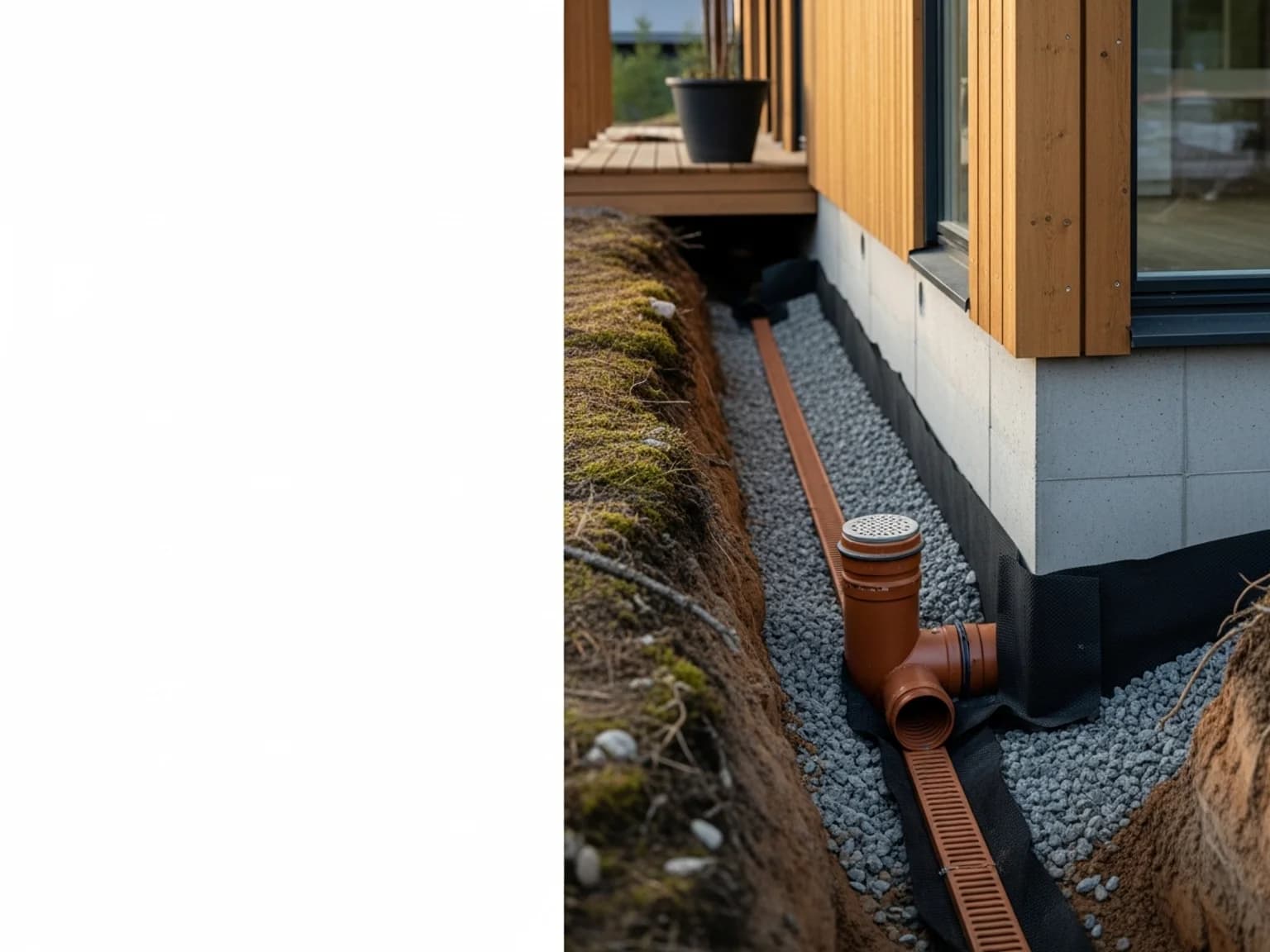
A drainage system consists of several components: drainage pipe, drainage inspection chambers, drainage gravel and filter fabric. The drainage pipe is a 110 mm (single-family house) or 160 mm (larger building) diameter perforated plastic pipe (PEH or PP). The perforations are on the upper part of the pipe so that water can enter but solids do not block the pipe from below.
The pipe is installed at the level of the bottom of the foundation footing or below it. This is a critical elevation — if the pipe is too high, it does not collect water before the water is already in contact with the foundation structures. The pipe slope is at least 1% (1 cm/m), and it falls towards the collection chamber or discharge point.
The pipe is surrounded by drainage gravel (#6–16 mm), which acts as a conductor of water to the pipe. Filter fabric (geotextile) is installed around the gravel to prevent fine soil material from penetrating the gravel layer and blocking the pipe. The gravel layer thickness is at least 100 mm around the pipe. The entire structure is approximately 300–400 mm wide and 400–500 mm high.
The importance of drainage inspection chambers
A drainage system includes inspection chambers at every corner (at least 4 in a single-family house) and a collection chamber where all drains converge. Inspection chamber diameter is typically 315–400 mm and they enable checking the system's functioning and flushing.
From the inspection chamber, the drainage system's functioning can be visually assessed: the water level in the chamber must not be above the drainage pipe. If the water rises above the pipe, the system is not working properly — the pipe may be blocked, the slope incorrect or the capacity insufficient. Inspection should be carried out at least once a year in spring.
From the collection chamber, water is either pumped or directed by gravity off the property. Gravity discharge to the municipal sewer is the best solution. If the property elevation does not allow gravity discharge, a pumping station is needed. An infiltration solution (infiltration field) can also be sought for drainage water if the soil is permeable. Connection to the municipal sewer requires a permit and a connection fee.
Drainage renewal and renovation
The service life of drainage is typically 30–50 years. In older houses (before the 1990s), drains are often clay or concrete pipe that deteriorates and becomes blocked over time. Even in plastic drainage pipes, the filter fabric can become clogged with fine soil material in 20–30 years, especially in clay-rich soils.
Drainage renewal is a major renovation requiring excavation around the entire building perimeter down to the bottom of the foundation. At the same time, it is worth renewing the foundation waterproofing (bitumen membrane or bitumen coating) and thermal insulation (XPS board). The typical price of a drainage renovation for a single-family house is 15,000–40,000€, depending on the house size, soil conditions and excavation conditions.
Signs that renovation is needed include basement or ground-floor moisture problems, elevated water levels in inspection chambers, cracks in foundations or ground surface settlement beside the plinth. If you suspect drainage malfunction, commission a professional condition survey where the drains are inspected with a pipe camera and their condition is assessed comprehensively. The survey price is approximately 500–1,500€.
Drainage and the stormwater system
Drainage and the stormwater system work together in a building's moisture management, but their tasks are separate. The stormwater system handles surface water from the roof, while drainage handles water in the soil. Both must function for the building to stay dry.
A common mistake is combining stormwater pipes and drains in the same system. During heavy rain, the high flow of stormwater can back up the drainage pipe, preventing soil water from draining away from the foundation. Finnish building regulations and most municipalities require separate pipe networks for stormwater and drainage water. The systems only merge at the pumping station or collection chamber.
Property ground surface grading supports both systems. Beside the plinth, the ground surface must slope away from the building at least 5% (1:20) over a distance of three metres. This directs surface water away from the building and reduces the load on the drainage system. Missing ground surface grading is one of the most common moisture-technical errors in Finnish single-family house construction, and it is easy and inexpensive to correct.
Related terms
Want to learn more?
Read the full guide on this topic→
Request a roofing quote and enter a draw for a €1,000 gift card!
Submit a quote request — you're automatically entered. Winner drawn on 30 June 2026.
€1,000 gift card
Valid for all our roofing services
All quote requests are automatically entered. Rules: kotikatto.fi/arvonta
Content reviewed and verified
Updated: April 2026