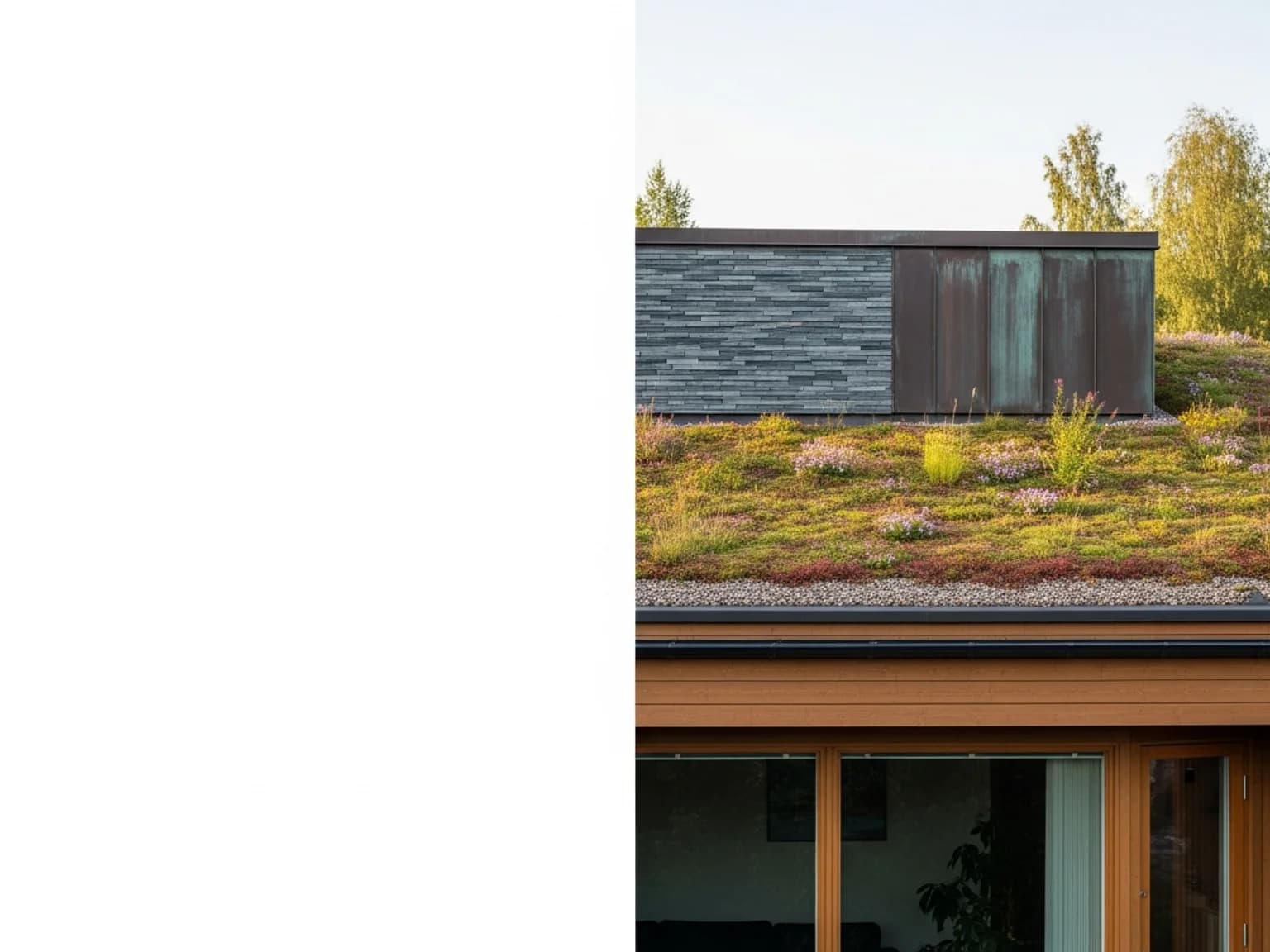
A green roof, also known as a vegetated roof, is a roof structure on whose surface vegetation has been planted. It is not merely an aesthetic solution but a functional system that combines waterproofing, a growing medium, and vegetation into a multifunctional whole. In Finland, green roofs have become more common from the 2010s onwards, especially on urban apartment buildings, office buildings, and public buildings. The popularity of green roofs is driven by several factors: they delay and filter stormwater, improve the building's energy efficiency, extend the service life of the waterproofing membrane, reduce the urban heat island effect, and increase biodiversity. In many Finnish municipalities, green roofs are positively considered in land use planning and building permits. Green roofs are divided into three types: extensive (thin growing medium, mosses and sedums), semi-intensive (medium-thick growing medium, perennials and grasses), and intensive (thick growing medium, shrubs and even trees). In Finland's climate, the extensive green roof is the most common and most economically sensible solution, as it requires the least maintenance and places the least load on the structure.
Types and structure of green roofs
The extensive green roof is the most common type in Finland. Its growing medium layer is thin, approximately 40–150 mm, and the vegetation consists of drought- and frost-resistant species such as sedums (Sedum), mosses, meadow flowers, and grass species. The weight is approximately 40–150 kg/m² depending on the growing medium thickness. Maintenance requirements are minimal — mainly weed removal and fertilisation 1–2 times per year.
An intensive green roof resembles a garden: the growing medium layer is 200–1000 mm and the vegetation can include lawn, perennials, shrubs, and small trees. The weight can reach as much as 300–1000 kg/m², which requires a significantly more robust load-bearing structure. An intensive green roof is typical on large public buildings and shopping centres.
The layers of a green roof structure from bottom to top are: load-bearing structure, vapour barrier, thermal insulation, waterproofing membrane, root barrier, drainage/storage layer, filter fabric, growing medium, and vegetation. Every layer is critical to the overall system's performance — especially the quality of the waterproofing membrane and root barrier determines the roof's longevity.
Stormwater management and environmental benefits
The most significant functional benefit of a green roof is stormwater management. An extensive green roof typically retains and evaporates 40–60% of annual rainfall, an intensive one up to 70–90%. This significantly reduces the load on storm sewers and the risk of flooding in urban areas. The guidelines of the Finnish Ministry of the Environment recognise green roofs as an effective stormwater management measure.
Improved energy efficiency is another significant benefit. The growing medium and vegetation act as additional insulation, reducing the building's cooling needs in summer and heating losses in winter to some extent. Studies show that a green roof can reduce heat loss through the upper floor by 10–15% and cooling energy demand by up to 25%.
Green roofs are an effective means of combating the urban heat island effect. Vegetation evaporates water and absorbs solar radiation, which lowers the roof surface temperature by as much as 30–40°C compared to a conventional bitumen roof. In terms of biodiversity, green roofs create habitats for insects, birds, and plants — a meadow-like extensive green roof can contain dozens of plant species and attract pollinators.
Design and installation in Finland
Designing a green roof in Finland requires specialised expertise that combines structural engineering, waterproofing, and landscape construction. In dimensioning the load-bearing structure, the weight of the growing medium both dry and saturated must be considered, as well as the snow load — the total weight can be significant, especially for intensive green roofs.
Waterproofing is the most critical component of a green roof, as locating a leak beneath the vegetation layer is extremely difficult and expensive. Recommended waterproofing materials are double-layer bitumen membrane or a continuous modified bitumen membrane. The root barrier prevents plant roots from penetrating the waterproofing membrane — without it, roots can damage the membrane within a few years.
The drainage layer ensures that standing water does not remain in the growing medium, which could damage plants and structures. In Finland, plastic drainage mats are commonly used, which store water in downward-facing cells and direct excess water to gutters. The RT 85-11205 instruction card provides guidelines for the design and implementation of green roofs in Finnish conditions.
Costs and maintenance
The cost of a green roof varies significantly by type and scale. An extensive green roof costs approximately 80–150€/m² installed, an intensive one 150–300€/m² or more. The price includes waterproofing, root barrier, drainage layer, growing medium, vegetation, and installation work. Any necessary reinforcement of the load-bearing structure is a significant additional cost.
The maintenance cost of an extensive green roof is approximately 2–5€/m² per year — mainly fertilisation, weed removal, and drainage inspection. An intensive green roof requires regular garden maintenance and the cost can be 10–30€/m² per year.
In the long term, a green roof can be an economically sensible investment. Protecting the waterproofing membrane from UV radiation and temperature fluctuations can extend its service life by up to double — a conventional bitumen membrane lasts 40–50 years under a green roof instead of needing replacement every 20–25 years. Energy savings and possible reductions in stormwater charges further improve the return on investment.
Related terms
Want to learn more?
Read the full guide on this topic→
Request a roofing quote and enter a draw for a €1,000 gift card!
Submit a quote request — you're automatically entered. Winner drawn on 30 June 2026.
€1,000 gift card
Valid for all our roofing services
All quote requests are automatically entered. Rules: kotikatto.fi/arvonta
Content reviewed and verified
Updated: April 2026