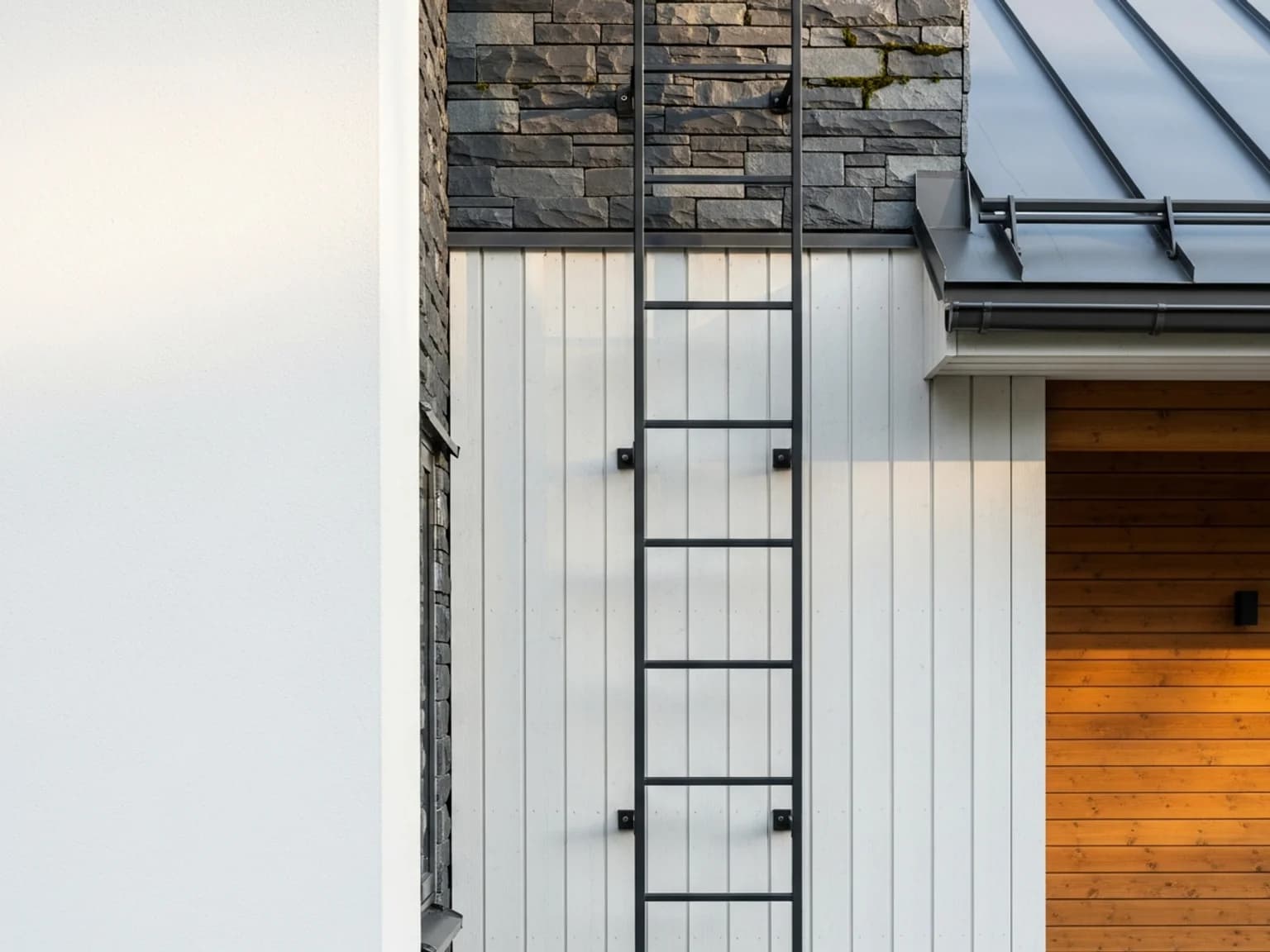
Access ladders are fixed metal ladders attached to the exterior wall of a building, used to climb from ground level to the roof. They are an essential part of the roof safety product system and form the first link in a safe access route to roof maintenance points. Without proper access ladders, reaching the roof requires portable ladders, which pose a significant safety risk. The Finnish Land Use and Building Act together with the National Building Code require access ladders on all buildings over two storeys. The obligation also applies to lower buildings that have a chimney requiring sweeping, provided there is no other safe route to the roof. Access ladders must comply with standard SFS-EN 516 and withstand a minimum point load of 150 kg. Access ladders are usually placed at the rear of the building or another inconspicuous location, but the placement must allow unobstructed access and a safe transition to roof ladders. The lowest rung must be at least 100 cm above ground level to prevent vandalism.
Types and materials of access ladders
Access ladders are manufactured mainly from hot-dip galvanised steel or aluminium. Hot-dip galvanised steel is the most common choice thanks to its durability and affordability — the zinc coating protects the steel from corrosion for decades. Aluminium ladders are lighter and are especially suitable for coastal areas where salt air accelerates steel corrosion.
Structurally, access ladders are divided into tubular and plate-type ladders. Tubular ladders are the most common, consisting of two vertical tubes and cross-rungs. Plate-type ladders are narrower and visually less conspicuous. Both types are fixed to the wall with steel brackets that must be anchored to the load-bearing structure.
The typical ladder width is 400–500 mm and rung spacing no more than 300 mm. For taller buildings (over 8 m), a fall-arrest rail or back guard conforming to EN 353-1 is required. The fall-arrest rail allows attachment of a fall-arrester during ascent, which is particularly important for professionals who use the ladders regularly.
Installation requirements and regulations
Access ladder installation is strictly regulated. The RT 85-11132 guideline card specifies installation details including the number of fixing points, distances and load requirements. Ladders must be fixed to the load-bearing structure — not merely the facade cladding — and at least one mounting bracket is required for every 1.2 metres.
The top of the access ladder must extend at least 300 mm above the eaves to allow a safe transition to the roof ladder. Special attention must be paid to the transition point, as it is statistically one of the most dangerous areas when moving on a roof. A dedicated transition piece is often used at the top to guide the climber onto the roof ladder.
Building control inspects roof safety products at the commissioning inspection. Missing or defective access ladders can lead to refusal of the building occupancy permit. In existing buildings, ladders must be added no later than during a roof renovation. In housing companies, the board is responsible for ensuring that roof safety products are in good condition and compliant with regulations.
Maintenance and inspection
Access ladders should be inspected at least once a year as part of annual roof maintenance. The inspection focuses on corrosion damage, strength of fixing points, condition of rungs and any deformations. Damaged ladders are a serious safety hazard and must be repaired or replaced immediately.
In winter, using access ladders requires extra caution. Ice and snow make rungs slippery, and cleaning the ladders before use is recommended. Anti-slip surfaces are available for the rungs at some sites, improving safety in wet and icy conditions.
The chimney sweep checks the condition of access ladders during each sweep visit and may report deficiencies to the rescue authority. Under the Rescue Act, the building owner must ensure there is a safe access route to the roof for the sweep and maintenance personnel. Neglect may lead to penalty payment proceedings.
Costs and practical installation
The price of access ladders varies depending on building height and ladder type. A typical access ladder purchase for a detached house costs 200–600 euros for materials depending on the model. Installation cost is approximately 300–500 euros, so the total cost for one access ladder is 500–1,100 euros installed.
Installation takes an experienced installer typically 2–4 hours per ladder. The work requires locating the load-bearing wall structure, drilling holes and fastening brackets. Sealing the fixing points is important to prevent moisture from entering the wall structure through the screw holes.
Access ladders are best installed during a roof renovation, when they can be planned as part of the entire roof safety product system together with roof ladders, roof walkways and snow guards. Comprehensive planning ensures the safe access route covers all maintenance points and meets regulatory requirements. The total cost of roof safety products for a detached house is typically 2,000–5,000 euros installed.
Related terms
Want to learn more?
Read the full guide on this topic→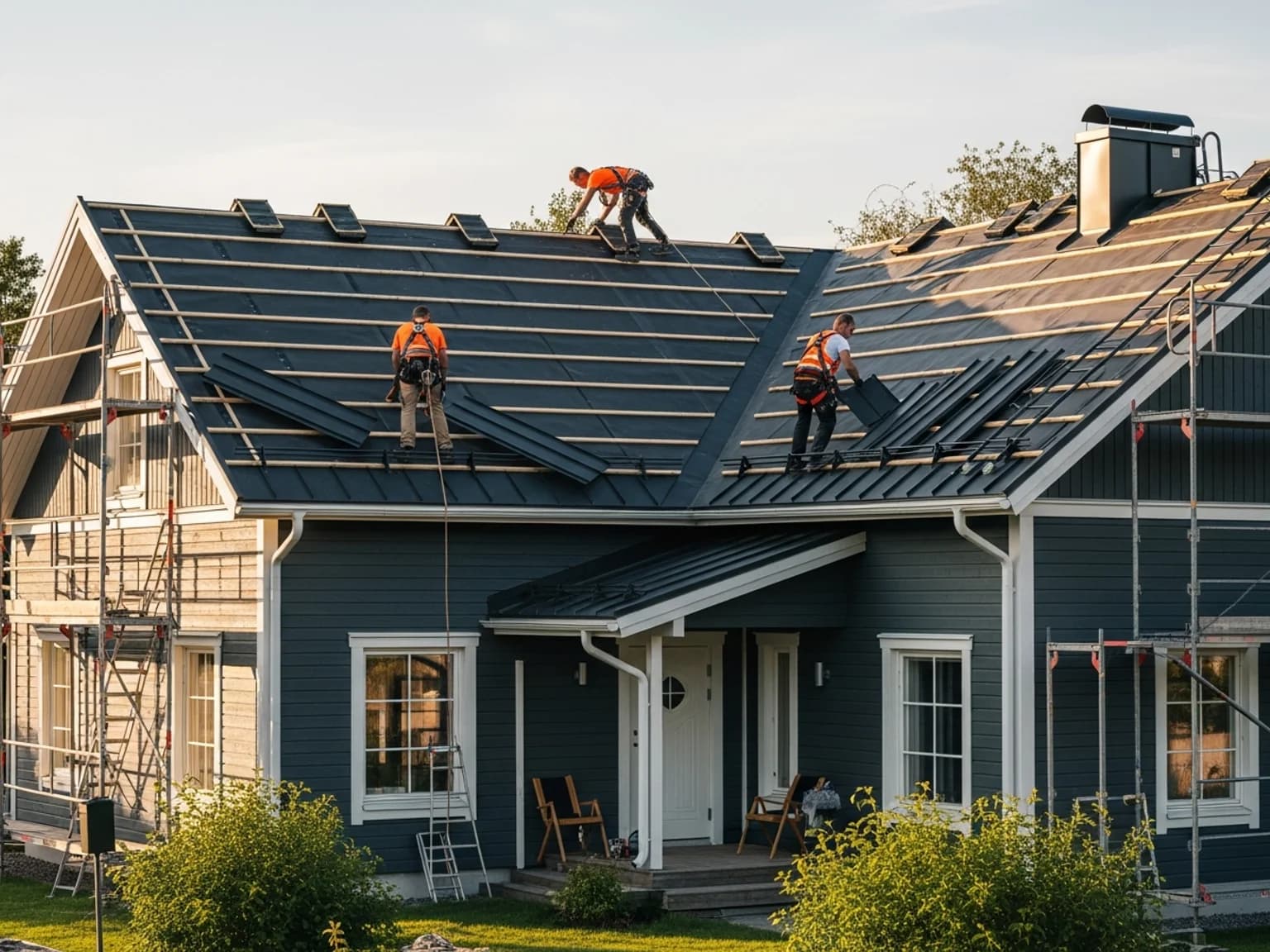
Request a roofing quote and enter a draw for a €1,000 gift card!
Submit a quote request — you're automatically entered. Winner drawn on 30 June 2026.
€1,000 gift card
Valid for all our roofing services
All quote requests are automatically entered. Rules: kotikatto.fi/arvonta
Content reviewed and verified
Updated: April 2026