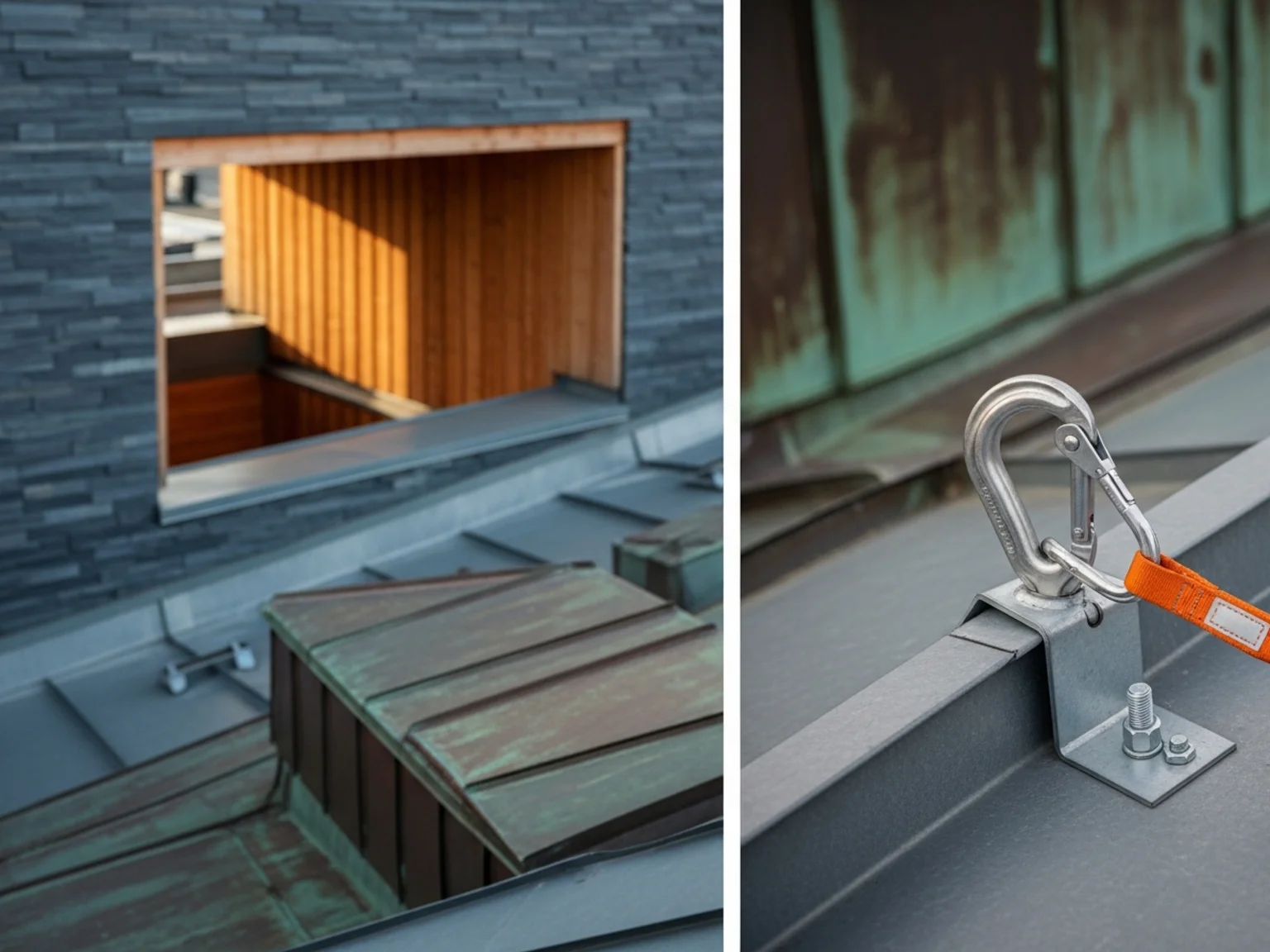
Roof safety hooks are metal anchor points fixed to the roof that serve as attachment points for personal fall protection equipment. When working on the roof, the worker attaches the harness lanyard to the safety hook, preventing a fall or keeping the fall distance short. Safety hooks are a key part of personal fall protection and supplement the fixed access routes (ladders, walkways). In Finland, roof safety hooks are mandatory on roofs with a pitch exceeding 1:8 (approximately 7 degrees). In practice, this means all gable roofs. The requirement is based on the Land Use and Building Act and the Ministry of the Environment decree on safety of use. Safety hooks are dimensioned and tested according to EN 517, which defines the hook's load-bearing capacity and test methods. Roof safety hooks are especially important for the safety of roof renovations and maintenance work. By law, a professional roofing worker may not work at heights over 2 metres without fall protection. Permanently installed safety hooks speed up the start of work, as no separate scaffold or hoist is needed to arrange fall protection.
Safety hook types and standards
Standard EN 517 classifies roof safety hooks into two types. Type A withstands loading in the direction of the roof slope and is suitable for situations where a fall would occur along the roof surface. Type B withstands loading both along the slope and perpendicular to it, making it the more versatile choice.
In practice, most safety hooks on the market are Type B and withstand a minimum load of 10 kN in both directions. This corresponds to approximately one tonne of pull force, which is sufficient to arrest a falling person safely. The hook must withstand the load without fracture and with permanent deformation remaining below the permitted limit.
Roof safety hooks are manufactured from stainless steel or hot-dip galvanised steel. Stainless steel is the more durable option and is recommended especially in coastal areas. Hook shapes vary: the traditional form is a U-shaped hook, but eyelet and ring models are also available. The choice depends on the type of fall-arrest device and the attachment method used.
Installation and positioning
Roof safety hooks are fixed to the rafter (roof truss) or other load-bearing element with screws or bolts. The fixing must withstand the load specified by EN 517, so batten-only fixing is insufficient. The hook's foot plate runs under the roofing material and emerges above the covering at the hook point.
On metal sheet roofs, the hook's foot plate is installed under the sheet and the hook emerges from the seam between sheets or through a dedicated penetration. On tile roofs, the hook foot plate is placed under the tiles and the hook rises between tile courses. Installation must be carried out during roofing or re-roofing, as retrofitting requires opening the roofing material.
Safety hooks are positioned so there are enough to cover the entire work area. Hooks are typically placed 2–3 metres apart on both sides of the ridge. The positioning must take into account that the safety line length limits the work area — hooks placed too far apart do not provide adequate protection.
Use and fall protection
Using a roof safety hook requires personal fall protection equipment consisting of a safety harness, a connecting lanyard and an energy absorber. The harness is put on and the lanyard is connected to the safety hook with a carabiner. The energy absorber limits the stopping force in the event of a fall — without it, the sudden stop can cause serious injuries.
Only one person may be attached to a safety hook at a time, unless the hook is specifically dimensioned for simultaneous use by more than one person. The lanyard length is chosen so the free fall distance remains as short as possible — no more than 2 metres including the energy absorber.
The Occupational Safety and Health Act obligates the employer to arrange fall protection for all work performed at heights over 2 metres. Roofing workers must receive training in the use of fall protection equipment and in inspecting safety hooks before use. Every safety hook is visually inspected before use — a damaged hook must never be used under any circumstances.
Costs and maintenance
The price of a single roof safety hook is approximately 30–80 euros depending on model and material. Installation cost is approximately 50–100 euros per hook. A typical detached house needs 4–8 safety hooks, so the total cost is 300–1,200 euros installed.
Safety hook maintenance is minimal but important. In the annual inspection, it is verified that the hooks are intact, the fixing is firm and no corrosion is detectable. According to EN 517, safety hooks must be load-tested after installation, and periodic inspections in accordance with the manufacturer's instructions must be carried out regularly.
A roof safety hook is a one-time investment that lasts the entire life cycle of the roof — a hook made of stainless steel is essentially permanent. During a roof renovation, existing hooks are inspected and replaced if necessary. The replacement cost is small compared to the safety benefit the hook provides and the statutory obligation it fulfils.
Related terms
Want to learn more?
Read the full guide on this topic→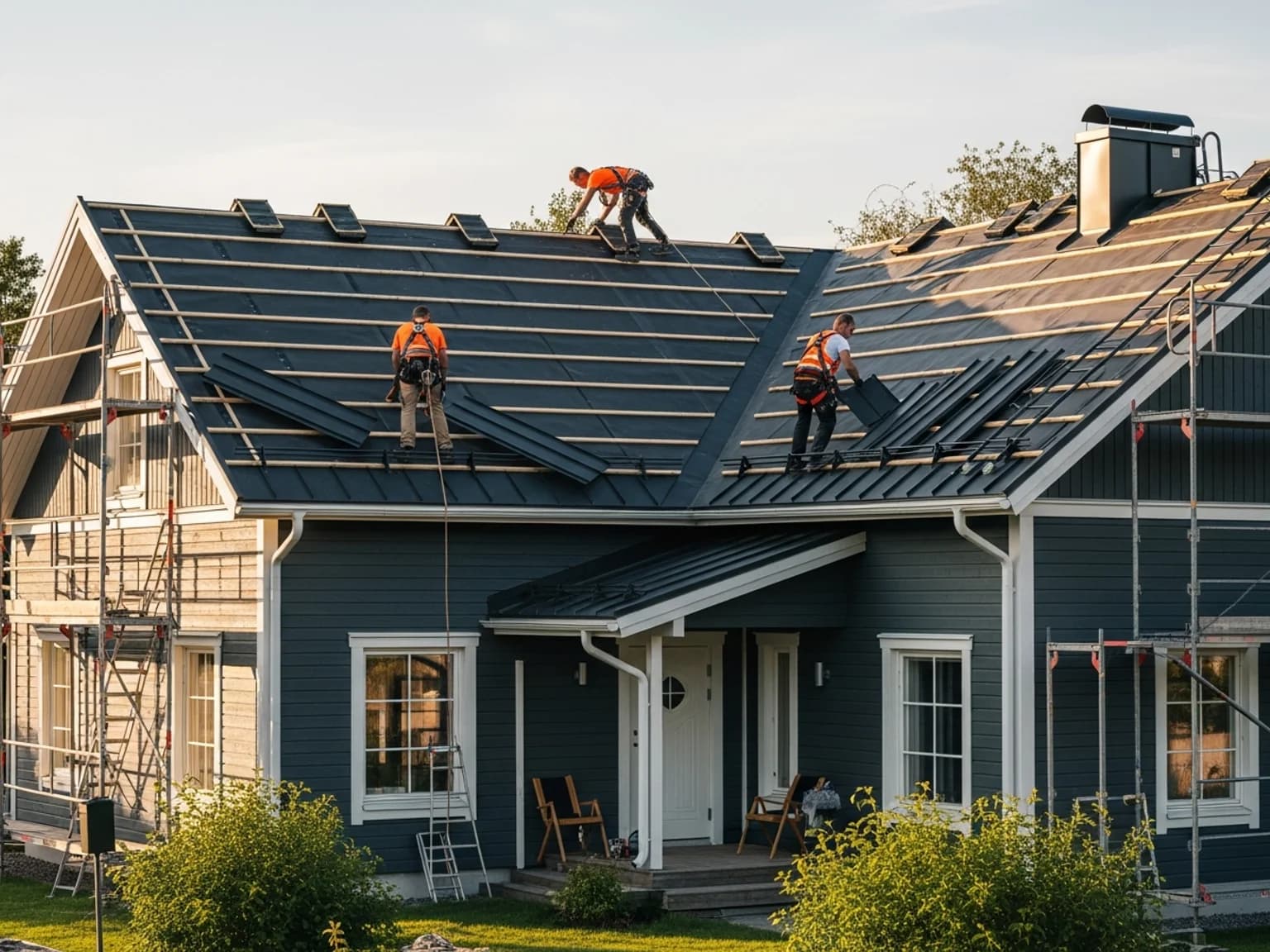
Request a roofing quote and enter a draw for a €1,000 gift card!
Submit a quote request — you're automatically entered. Winner drawn on 30 June 2026.
€1,000 gift card
Valid for all our roofing services
All quote requests are automatically entered. Rules: kotikatto.fi/arvonta
Content reviewed and verified
Updated: April 2026