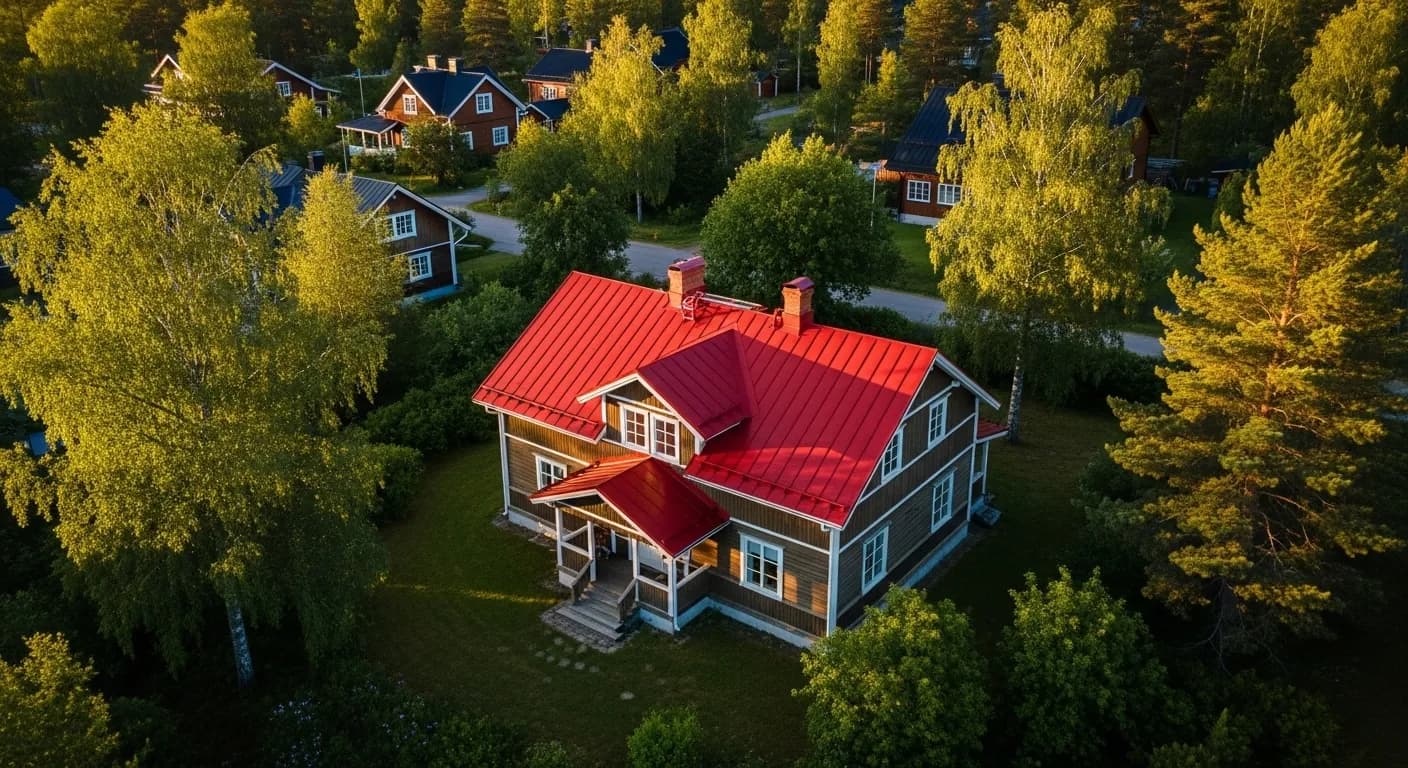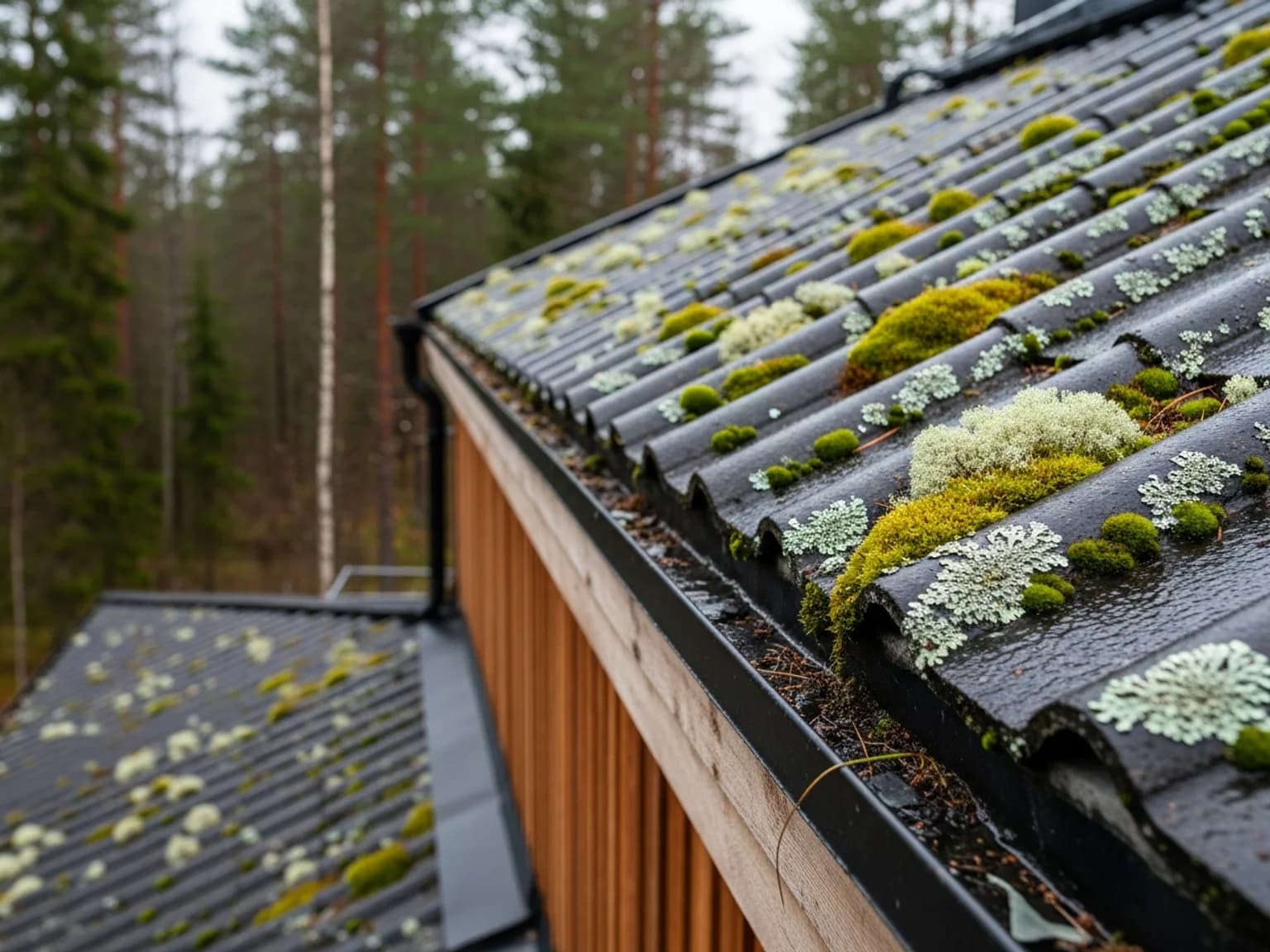
Moss and lichen are common biological growths on roof surfaces, especially on shaded and damp roof slopes. Moss is a green, soft plant that grows as a dense mat and absorbs water efficiently. Lichen is a fungus-algae composite that forms thin, often grey or yellow patches on the roof surface. Biological growth is not merely an aesthetic issue. Moss acts like a sponge — it absorbs and retains moisture on the roof surface, accelerating the deterioration of the roofing material. Lichen produces acids that corrode both concrete-based and bitumen-based materials. Together, these organisms significantly shorten the roof's service life if left untreated. The Finnish climate favours moss and lichen growth on roofs. Long autumns, damp winters and cool summers provide ideal conditions. North-facing and east-facing roof slopes are particularly susceptible because they receive little sunlight and dry slowly after rain. Roofs shaded by trees are worst affected.
Growing conditions and risk factors
Moss and lichen need moisture, light (but not too much direct sunlight) and a surface to attach to. Organic matter accumulating on the roof — leaves, needles, pollen — serves as a growth medium. The rougher the roof surface, the more easily biological growth adheres to it. That is why concrete tile roofs and asphalt shingle roofs are the most susceptible, while a smooth metal roof resists growth most effectively.
Shading is the most significant risk factor. Tree branches above the roof not only provide shade but also drop organic matter onto the roof. North-facing slopes receive less direct sunlight and dry more slowly. A low roof pitch slows water runoff and prolongs the period of dampness.
In addition to aspect and shading, the surrounding environment matters. Near a forest or park, spore and seed pressure is greater because they constantly drift onto the roof. In urban environments biological growth occurs less frequently but is not unknown. Damp micro-climate conditions such as proximity to a body of water increase the risk.
Effects on roofing materials
On concrete tile roofs, moss grows into the porous tile surface and penetrates the material's microstructure. The root system widens cracks in the same way as frost weathering, and the moisture retained by the moss further intensifies the weathering. Prolonged moss growth can weaken the tile surface to the point where it crumbles.
On asphalt shingle roofs, moss dislodges the protective granules embedded in the shingle surface that serve as UV protection and a wear layer. Loss of granules exposes the bitumen to direct UV radiation, which accelerates embrittlement and cracking. The acids produced by lichen corrode the bitumen binder and weaken the shingle structure.
On felt roofs, the moisture retained by moss penetrates the felt's seams and overlap joints. Repeated freezing and thawing widens gaps, and eventually the felt's watertightness fails. On metal roofs, biological growth is less common, but growth accumulating at eaves joints and around screws can accelerate corrosion by retaining moisture against the metal surface for extended periods.
Cleaning and moss removal
Roof cleaning from moss and lichen is done mechanically and chemically. Mechanical cleaning means brushing or scraping moss off the roof surface with a soft brush. Pressure washing should be avoided or used very cautiously, as excessive pressure damages the roofing material surface — especially asphalt shingle granules and concrete tile coatings.
Chemical treatment is applied after cleaning with an anti-moss treatment. Several roof anti-moss and algicide products are available on the market that prevent regrowth for 3–5 years. The treatment is applied by spreading the product on the roof surface and allowing rain to wash it across the roof over time. Environmentally toxic products should be avoided, especially if rainwater drains into the ground or a watercourse.
Professional roof cleaning and treatment typically costs 5–15 euros per square metre depending on roof size and extent of growth. Cleaning and treating a detached house roof costs a total of 800–2,500 euros. Cleaning is best done in autumn on a dry day when moss loosens most easily and the treatment product adheres well.
Prevention
The most effective prevention is cutting tree branches above the roof. This reduces shading, improves roof drying and reduces organic matter accumulation on the roof. The distance from trees to the roof should be at least 2–3 metres so that branches do not extend over the roof.
Regular cleaning of debris from the roof — leaves, needles, pollen — removes the growth medium. Cleaning is done with a soft brush or leaf blower 1–2 times a year. Cleaning gutters prevents water from backing up and reduces moisture in the eaves area.
Anti-moss treatment every 3–5 years keeps growth under control. Some roofing materials are also available with factory-applied anti-moss coatings — for example concrete tiles whose surface has been treated with algicide during manufacture. When choosing a new roof, the material's susceptibility to biological growth is worth considering: a smooth metal roof is the most resistant, while rough concrete tile is the most susceptible.
Related terms
Want to learn more?
Read the full guide on this topic→
Request a roofing quote and enter a draw for a €1,000 gift card!
Submit a quote request — you're automatically entered. Winner drawn on 30 June 2026.
€1,000 gift card
Valid for all our roofing services
All quote requests are automatically entered. Rules: kotikatto.fi/arvonta
Content reviewed and verified
Updated: April 2026