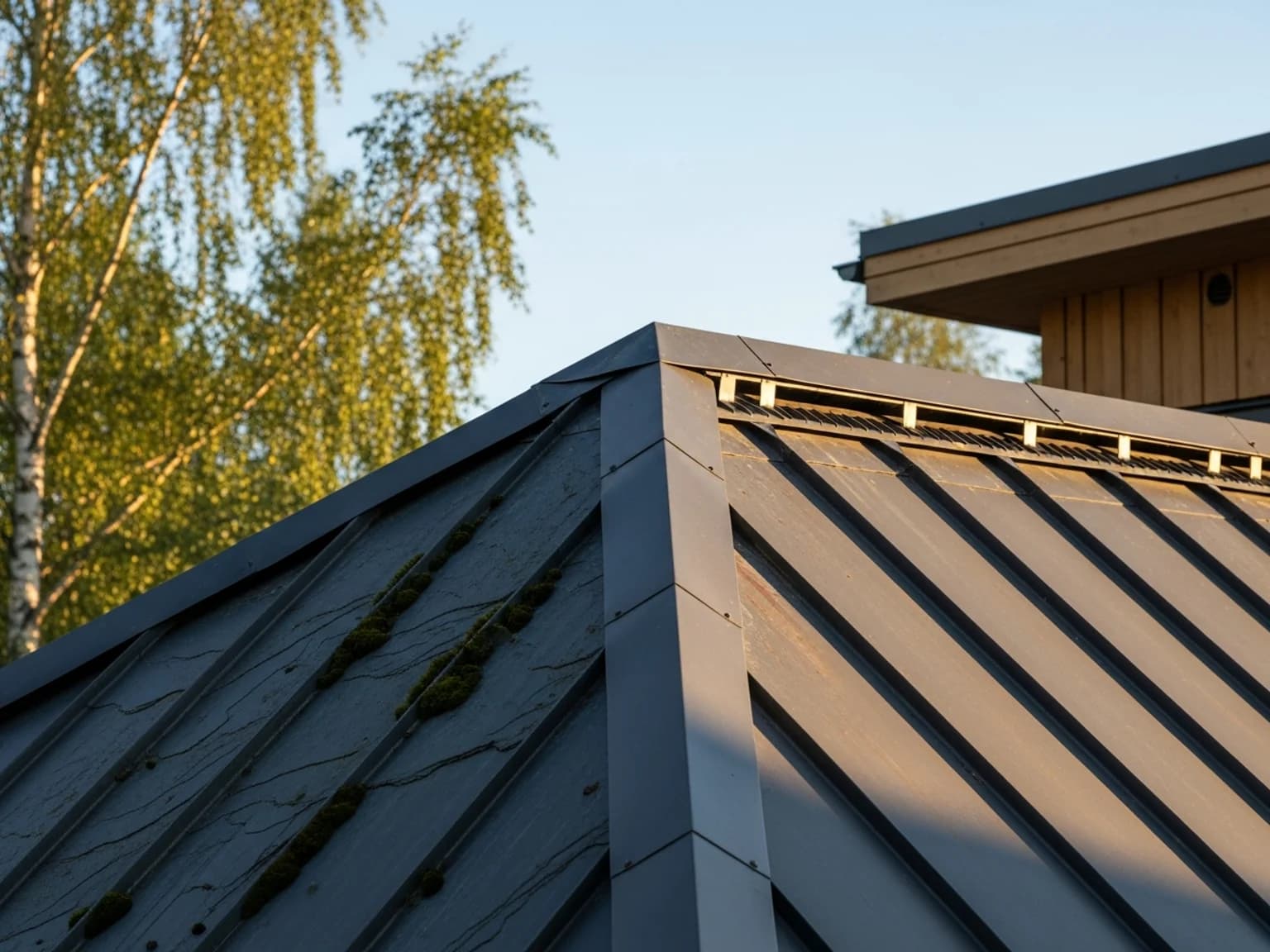
Ridge flashings are metal protective caps covering the ridge line of a roof, whose function is to seal the gap left at the upper edge where two roof slopes meet. Without ridge flashing, rainwater, snow, and wind would penetrate directly into the roof structure through the ridge. Ridge flashing is therefore one of the most critical details of a roof in terms of waterproofing. The design of ridge flashings requires a balance between sealing and ventilation. The roof ventilation space needs an exit route for moist air, and the ridge is a natural location for exhaust air openings. Therefore, ridge flashings are often equipped with ventilation gaps or installed slightly raised from the roof surface, allowing air to circulate. In Finland, ridge flashings are generally manufactured from the same material as the rest of the roof sheeting — hot-dip galvanised and coated steel sheet. They are available in all common RR colour shades and profiles to match the rest of the roof cladding.
Types and materials of ridge flashings
Ridge flashings are divided into traditional single-profile ridge flashings and ventilated ridge flashings. A traditional ridge flashing is a simple bent sheet metal profile that is nailed or screwed onto the roof sheeting along the ridge line. A ventilated ridge flashing includes a separate ventilation element or spacer blocks that keep the ridge flashing raised from the roof surface, enabling air circulation.
The material used is 0.5–0.6 mm hot-dip galvanised steel sheet, coated with the same coating as the roof sheeting — most commonly polyester or polyurethane. Aluminium ridge flashings are used less frequently, mainly in projects where the rest of the roof is also aluminium.
The width of a ridge flashing is typically 200–300 mm on each slope. Individual pieces are 1–2 metres long and are installed overlapping with approximately 50–100 mm overlap. Joints are sealed as necessary with sealant or EPDM tape. On profiled roofs, a sealing strip is also used between the ridge flashing and the roof profile, preventing water and snow from penetrating into the profile corrugations.
Installation and ensuring ventilation
Ridge flashing installation is the finishing stage of roofing work, carried out once the roof sheet installation is complete. The ridge flashing is fixed with screws directly to the roof sheeting and the batten beneath it. The fixing screws must have EPDM washers to ensure the fixing points remain watertight.
Ensuring ventilation at the ridge is a critical design consideration. Building regulations require adequate air circulation in the roof ventilation space to remove moisture. The total area of ventilation openings at the ridge must be at least 2 per mille of the roof area. In a ventilated ridge flashing, this is achieved through the gap left by spacer blocks.
Installation errors with ridge flashings frequently lead to leaks or insufficient ventilation. The most common errors are missing sealing strips, insufficient overlap between pieces, and blocking of ventilation openings. A skilled installer ensures that the ridge flashing is both watertight and ventilation-permitting — both requirements must be met simultaneously.
Maintenance and common problems
The condition of ridge flashings is checked as part of the annual roof maintenance inspection. The inspection focuses on the tightness of fixing screws, condition of seals, deformation of the sheets, and possible corrosion damage. The openness of ventilation openings is verified — they can become blocked by leaves, bird nests, or insect nests.
The most common problem with ridge flashings is leakage at joints. Thermal expansion causes the sheet metal pieces to move, which over time can loosen fixings and open lap seams. Particularly vulnerable to leaks are points where the ridge flashing meets chimney flashing or other penetrations.
A ridge flashing dislodged by wind must be repaired immediately, as an open ridge exposes the entire roof structure to rain and wind loads. The cost of replacing ridge flashing is approximately 10–20€/lm for materials and 25–45€/lm installed. Overall, ridge flashing represents a small portion of the total roof cost but a significant part of its waterproofing.
Related terms
Request a roofing quote and enter a draw for a €1,000 gift card!
Submit a quote request — you're automatically entered. Winner drawn on 30 June 2026.
€1,000 gift card
Valid for all our roofing services
All quote requests are automatically entered. Rules: kotikatto.fi/arvonta
Content reviewed and verified
Updated: April 2026