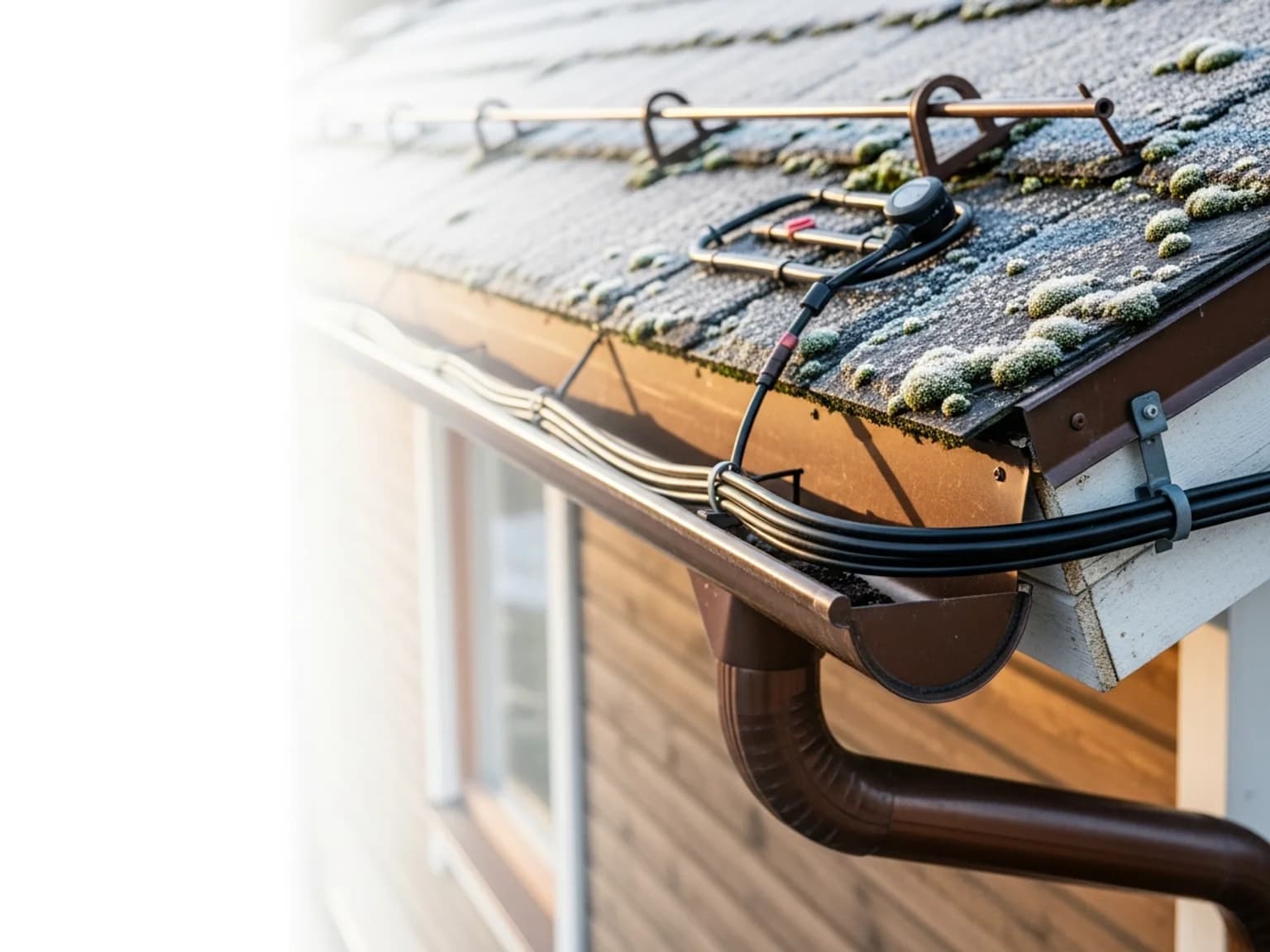
Heating cables are electrically powered de-icing cables installed in eaves gutters, downspouts and where necessary along the roof edge to prevent ice formation. In Finland's climate, where winter lasts 4–7 months and the temperature fluctuates around freezing, icing is the greatest threat to the stormwater system. Ice dams and frozen downspouts cause millions of euros in damage to Finnish properties every year. A frozen gutter can easily weigh 50–100 kg/m, which tears brackets loose and damages eaves structures. Furthermore, ice dams prevent meltwater from draining off the roof, allowing water to penetrate beneath the underlayment and cause moisture damage to the roof structure. Heating cables are the most effective and reliable solution to these problems. A properly designed and installed heating cable system keeps gutters and downspouts ice-free throughout winter, minimises the risk of ice dams and significantly extends the service life of the gutter system. The typical payback period is 3–5 years compared to ice damage repair costs.
Cable types: self-regulating vs. constant power
There are two main types of heating cables: self-regulating and constant power. A self-regulating cable automatically adjusts its output according to the ambient temperature — power increases in colder conditions and decreases in warmer ones. This is the most energy-efficient solution because the cable only consumes electricity as needed. A self-regulating cable typically delivers 15–30 W/m at 0°C.
A constant power cable produces the same output regardless of temperature. It is cheaper to purchase but consumes more electricity because the output does not adapt to conditions. The advantage of constant power is consistent and predictable performance even in extreme cold. The power rating is typically 18–30 W/m.
In Finland, self-regulating cable is recommended for almost all applications. Energy savings are 30–50 percent compared to constant power cable. Additionally, self-regulating cable does not overheat, which extends its service life and reduces fire safety risk. Cable service life is typically 15–25 years when correctly installed. Quality cables have a UV-protected outer sheath that withstands sunlight and mechanical stress.
Installation and dimensioning
Heating cable installation in eaves gutters is done by fixing the cable to the bottom of the gutter. The typical installation method is a single loop where the cable runs along the entire gutter bottom. In the downspout, the cable is installed as a U-loop: down and back up. This keeps the entire cross-section of the pipe ice-free.
Power requirements depend on the application: 30–40 W/m for eaves gutters and 40–60 W/m for downspouts. When installed on the roof edge, the power is 200–300 W/m² of treated surface area. The typical total power for a single-family house is 1,500–4,000 W, resulting in electricity consumption of approximately 1,500–5,000 kWh per winter season. At current prices (approximately 10–15 cents/kWh), the electricity cost is 150–750€ per year.
Installation requires a qualified electrician. The cable is connected to its own fuse and residual current device (RCD) circuit (30 mA). Control is achieved with a thermostat and moisture sensor: the system activates automatically when the temperature is typically between -8°C and +3°C and the moisture sensor detects meltwater. This significantly reduces energy consumption compared to manual control.
Energy consumption and costs
The purchase price of a heating cable system for a single-family house is typically 2,000–5,000€ installed. The price includes cables, thermostat, moisture sensor and electrical installation work. Self-regulating cable is approximately 30–50 percent more expensive than constant power, but the energy savings compensate for the price difference within 2–4 years.
Annual energy consumption depends on the severity of the winter and the control method. With automatic thermostat control, consumption is typically 1,500–3,000 kWh for a single-family house. With manual control or timer-only control, consumption can be 2–3 times higher because the cable is on even when de-icing is not needed.
The return on investment is clear compared to ice damage repair costs. A single water damage repair caused by an ice dam can cost 5,000–20,000€, and renewing the gutter system due to ice damage costs 2,000–5,000€. A heating cable system typically pays for itself with the first prevented damage event. The labour cost qualifies for the household tax deduction.
Finland's climate and the importance of heating cables
In Finland, the temperature fluctuates around freezing (the freeze-thaw cycle) typically 50–100 days per year. Each cycle produces meltwater that can refreeze in the gutter or downspout. Particularly problematic are the variable conditions in November and March, as well as the south-facing roof slopes where the sun melts snow during the day but night frost refreezes the water.
Climate change has worsened the situation. Milder winters mean more freeze-thaw cycles, especially in southern and central Finland. Traditionally, the harsh cold of northern Finland kept the roof frozen all winter, but now mild spells are becoming more common there too. This increases the need for heating cables across the entire country.
From an energy efficiency perspective, a self-regulating cable combined with intelligent thermostat control is the best solution. The latest systems can be integrated into building automation and controlled remotely via a mobile application. This ensures optimal de-icing even when the occupant is away. The system investment cost is small compared to the total value of the roof and gutter system.
Related terms
Want to learn more?
Read the full guide on this topic→
Request a roofing quote and enter a draw for a €1,000 gift card!
Submit a quote request — you're automatically entered. Winner drawn on 30 June 2026.
€1,000 gift card
Valid for all our roofing services
All quote requests are automatically entered. Rules: kotikatto.fi/arvonta
Content reviewed and verified
Updated: April 2026