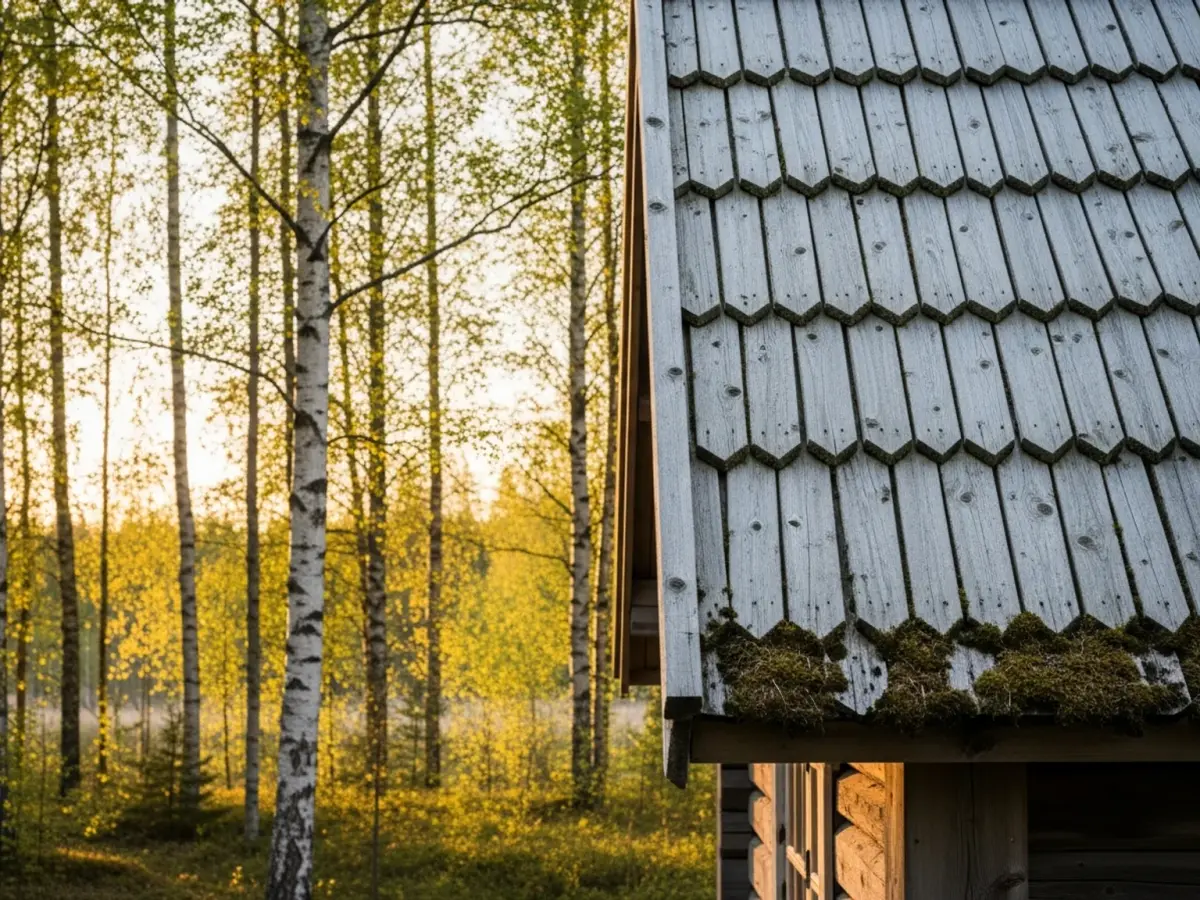
A wood shingle roof is one of the oldest known roof structures in Finland and the Nordic countries. Shingles are thin, approximately 5–10 mm thick and 30–60 cm long wood boards that are carved or split from log timber along the grain. In a traditional wood shingle roof, the shingles are laid in multiple overlapping layers on a steep roof, so that water flows from shingle to shingle down the roof in the same way as on a bird's feathers. A wood shingle roof represents Finnish building heritage at its best. It was the most common roof type in rural areas until the early 1900s, when industrial materials displaced it. Today, wood shingle roofs are mainly built for museum properties, restorations of culturally significant buildings, and new builds completed in the spirit of traditional construction. The raw material for shingle roofing in Finland is traditionally pine or spruce, sometimes also aspen. The quality of the wood and the method of manufacturing the shingles are decisive for the roof's durability. A split shingle is more durable than a sawn one, because splitting follows the wood grain and does not break the cell structure — this significantly slows water absorption and decay.
Shingle manufacturing and materials
Traditional shingle manufacturing is handwork. The log timber — preferably slow-grown, dense-grained pine — is split into thin boards using an axe or a shingle-cutting tool. Splitting is done from fresh timber, and the shingles are air-dried before installation. This method produces shingles with a smooth surface and intact grain, which improves water repellency.
Nowadays, shingles are also manufactured mechanically by sawing, but traditional builders prefer split shingles due to their superior durability. A sawn shingle absorbs significantly more water than a split one, because sawing cuts through the wood cells.
In the choice of wood species, softwoods are primary. Pine shingles last the longest due to their resinous nature — the service life is 25–40 years depending on climate conditions. Spruce shingles are more affordable but typically last only 15–25 years. Western red cedar is the internationally most valued raw material for shingles, but in Finland it is an imported material and expensive. Cedar shingles can last up to 50–60 years.
Installation and roof structure
The most important structural requirement of a wood shingle roof is a steep roof pitch. Traditionally, shingle roofs were built at a minimum of 35–45 degrees, sometimes even steeper. The steep pitch ensures that rainwater and snow drain quickly and do not soak into the shingles. At a low pitch, the shingles remain wet for too long, which significantly accelerates decay.
Shingles are fastened to roof battens with nails. In traditional installation, three layers of shingles are used — base, middle, and surface layers — which are overlapped so that water cannot pass through any joint. A two-layer installation is the minimum level, but a three-layer one is more durable and tighter.
A shingle roof does not use an underlay membrane as in modern roofing, because the ventilation of the structure is essential for the shingles to dry. Instead, below the decking there is an open ventilation gap that allows air circulation and moisture removal. This makes a shingle roof a naturally well-ventilated structure — moisture problems rarely occur when the roof is correctly built.
Durability, maintenance, and moss growth
The service life of a wood shingle roof varies significantly depending on the material, installation quality, and conditions. A well-made pine shingle roof lasts 25–40 years, a cedar shingle roof up to 50–60 years. On a shaded and damp site, the roof decays faster than on a sunny and windy site.
The greatest threat to a shingle roof is moisture and the resulting growth of decay fungi. Moss growth and lichen slow the drying of shingles and accelerate decay. Regular moss removal is an important maintenance task. Wood preservatives can extend the service life, but traditional builders often prefer untreated wood for reasons of authenticity.
Repairing a shingle roof is in principle straightforward: decayed shingles are replaced with new ones. In practice, however, large-scale shingle replacement can be laborious and expensive, as the work is handcraft. Costs vary significantly depending on the project size and quality of shingles. A traditional wood shingle roof is more of a prestige choice and cultural act than the most cost-effective solution.
Wood shingle roofs in modern Finland
Wood shingle roofs are currently built primarily in three contexts: restorations of culturally significant properties under the guidance of the National Board of Antiquities, projects by traditional construction enthusiasts, and ecological building. The National Board of Antiquities often requires the use of original roofing materials on protected properties, which maintains the shingle roofing tradition.
From an ecological perspective, a wood shingle roof is ideal: the raw material is local and renewable, manufacturing consumes only mechanical energy, and discarded shingles decompose naturally. The carbon footprint is negligible compared to industrial roofing materials.
In Finland, the number of shingle manufacturers and installers is limited. Traditional building courses are organised by local heritage associations and museums, among others. The price of shingles depends heavily on the manufacturing method — mechanically sawn shingles cost considerably less than hand-split ones. The total cost of a shingle roof varies greatly, but typically it is at the upper end of the tile and metal roof price range when the handwork component is taken into account.
Related terms
Want to learn more?
Read the full guide on this topic→
Request a roofing quote and enter a draw for a €1,000 gift card!
Submit a quote request — you're automatically entered. Winner drawn on 30 June 2026.
€1,000 gift card
Valid for all our roofing services
All quote requests are automatically entered. Rules: kotikatto.fi/arvonta
Content reviewed and verified
Updated: April 2026